Upper Structure Triads Explained: Big Dominant Chords from Simple Triads (Free 12-Key PDF)
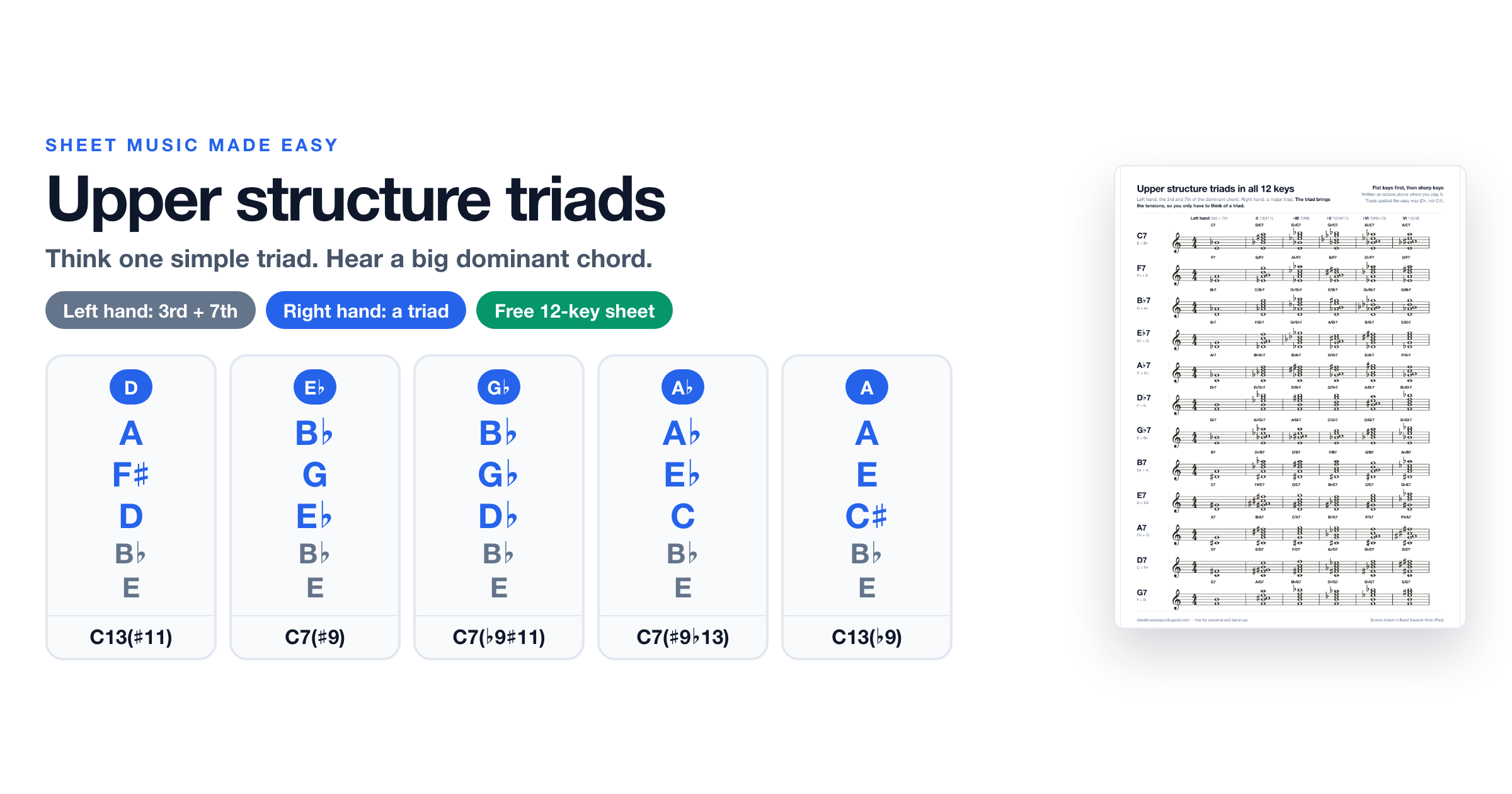
An upper structure triad is a plain major triad played in the right hand over the 3rd and 7th of a dominant chord in the left. You think “D major” and the band hears C13(♯11). Five triads give you five different dominant sounds, from bright to very dark, and each one is a shape you already know. The free sheet below has all five on all 12 dominant chords.
Build one
Start with C7: C, E, G, B♭. Keep only the 3rd and the 7th, E and B♭. Those two notes are what make the chord sound like a dominant chord, the same guide tones we traced through a ii–V–I. They go in your left hand. Now play a D major triad in your right hand, and put the two together. The triad is in blue.
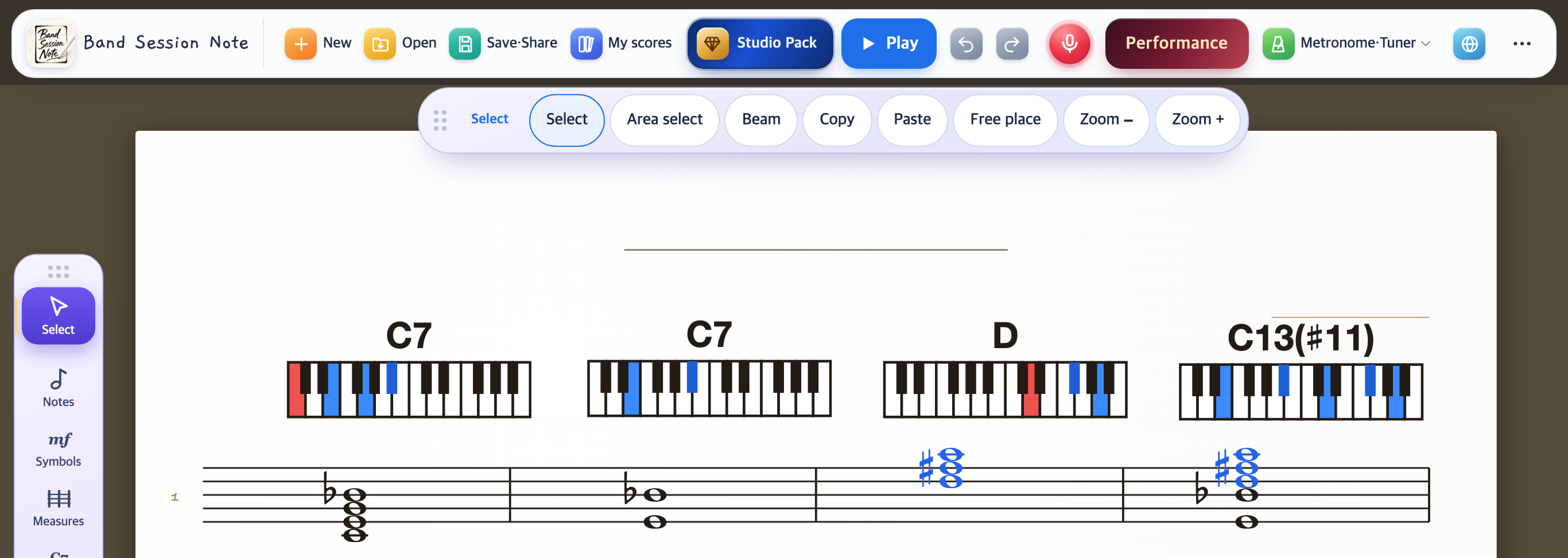
Against a C root, D is the 9th, F♯ is the ♯11 and A is the 13th. So the whole sound is C13(♯11), a long chord name for something you can find in a second. That is the point of the idea: the left hand says what the chord is, and the triad brings the tensions. On the keyboard diagrams, red marks the root of the chord named above, when that note is in the chord.
You will see this written as a fraction or with a slash: D/C7 means a D major triad on top of C7.
The five triads
Teachers name each triad by how far its root sits above the root of the dominant chord. D is a whole step above C, so it is the II triad. Keep the same E and B♭ in the left hand and change only the right hand. Some books call ♭V and ♭VI the ♯IV and ♯V instead; the notes are the same.
| Triad | Notes over C7 | What they are | Chord |
|---|---|---|---|
| II | D, F♯, A | 9, ♯11, 13 | C13(♯11) |
| ♭III | E♭, G, B♭ | ♯9, 5, ♭7 | C7(♯9) |
| ♭V | G♭, B♭, D♭ | ♯11, ♭7, ♭9 | C7(♭9♯11) |
| ♭VI | A♭, C, E♭ | ♭13, root, ♯9 | C7(♯9♭13) |
| VI | A, C♯, E | 13, ♭9, 3 | C13(♭9) |
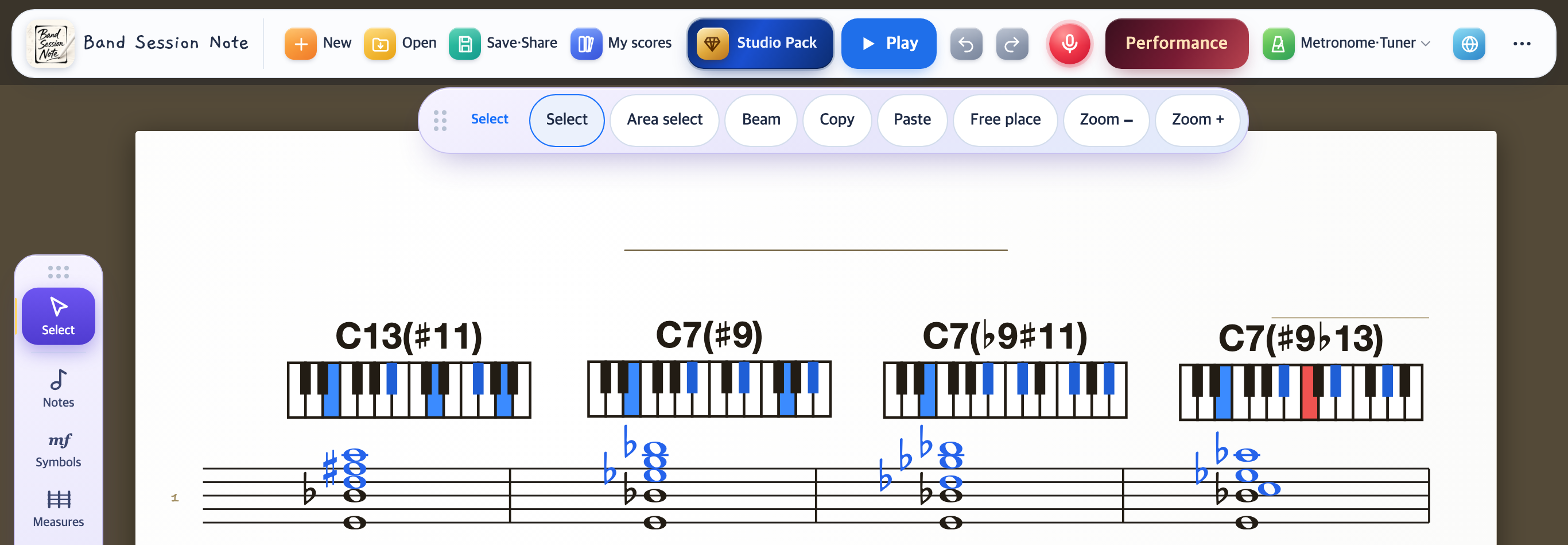
Here are the first four on the staff. The triads are stacked in whichever order sits closest above the left hand, and the fifth one, VI, is in the next picture. C7(♯9) may look familiar: it is the same chord type as the Hendrix chord. C7(♯9♭13) is also written C7(♯5♯9), because ♭13 and ♯5 are the same note.
Which one to use
Two things decide it: the melody note and where the chord is going.
In a ii–V–I
C7 is the V chord in the key of F, so here is Gm9 to C13(♭9) to F△9, with the VI triad on the C7. The right hand plays a triad on every chord: D minor, then A major, then C major.
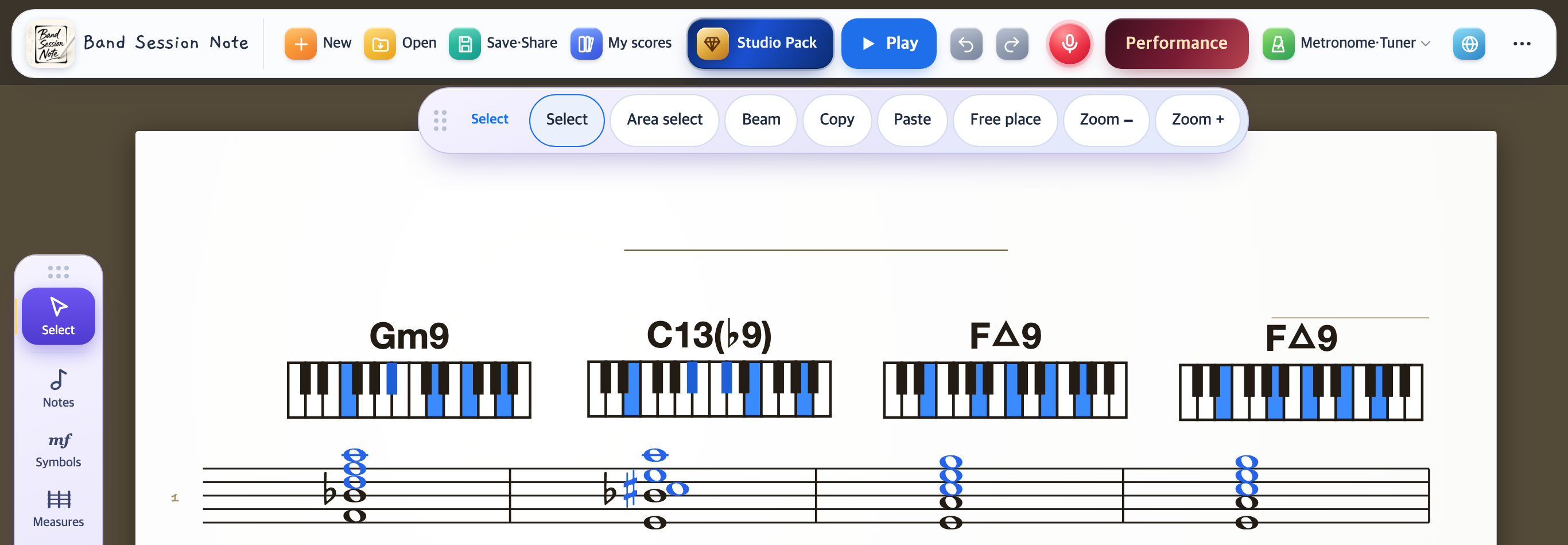
No note moves more than a whole step, so the big sound on the C7 slips in without any jump. The triads on the Gm9 and F△9 are built on the 5th of each chord, which adds the 9th on top in the same way.
Where to play them
The pictures and the free sheet are written in treble clef so that both hands are easy to read at a glance. Play everything one octave lower than written. The left hand then sits in the octave below middle C, and the right hand starts around middle C.
Keep the hands close. Teachers suggest no more than a perfect 5th between the top note of the left hand and the bottom note of the right. Every voicing on the free sheet stays inside that limit. If you need the triad higher, for a melody note, that is fine, but the sound starts to come apart as the gap grows.
The free sheet spells each triad the way players read it, so you will see D♭ major where the theory says C♯ major. Same keys, easier on the eye.
Four common mistakes
1. Trying any major triad. Not all twelve work. D♭ major over C7 has an F in it, and that F clashes with the E in your left hand.
2. Ignoring the melody. An A♭ triad under a melody on A puts two notes a half step apart. Pick the triad that contains the melody note.
3. Using them on chords that are not dominant. These five are built for the 3rd and ♭7 in the left hand. Over C△7, an E♭ triad brings a B♭ that fights the B of the chord.
4. Leaving a wide gap between the hands. With too much space, the ear hears two separate chords instead of one.
How to practise it
1. Print the sheet. Play the C7 line an octave lower than written: the left hand alone, then each triad in turn. Say the name of the sound as you play it.
2. Keep the left hand still and play one triad in all three inversions. Listen to how the top note changes the colour.
3. Pick one column and go down the page. The lines move around the circle of fourths, so each chord leads to the one below it: C7 to F7 to B♭7 and on.
4. Play the Gm9 to F△9 example above, then swap the A major triad for A♭ major or G♭ major and compare the sound.
FAQ
What is an upper structure triad?
A major triad played over the 3rd and 7th of a dominant seventh chord. The triad supplies the tensions, such as the 9th, ♯11 and 13th, so a complicated chord symbol turns into a simple right-hand shape.
What does D/C7 mean?
A D major triad on top of a C7 chord. It is different from the slash chord D/C, which is a D major triad over a single bass note C, with no E or B♭.
Which upper structures should I learn first?
If you only learn two, take VI for chords going to major and ♭VI for chords going to minor. Add II next for its bright sound.
Do I need the root in the left hand?
Not with a bass player. On your own, add it: E and B♭ are also the 7th and 3rd of G♭7, so without a low C the ear may not hear C7. Many pianists play C, E, B♭ in the left hand when they play alone, the same shell voicing from earlier in this series.
How is this different from rootless voicings?
Rootless voicings are four-note shapes for one hand, usually the left, on any type of chord. Upper structures use two hands and five notes, and they are mainly for dominant chords, where you want a bigger or more altered sound.
Does this work on guitar?
Yes, but five notes across two octaves is a stretch. A simple way in is to play only the triad on the top three strings, with the 3rd and 7th left to the piano or added on a lower string when you can reach them.
Every example on this page was written in Band Session Note, the iPad notation app I make. The pictures are the app’s own screen.


Comments
Post a Comment