Funk and Jazz Chords in A Minor: The Dorian Vamp, the Hendrix Chord and 25 More (Free Chord Finder)
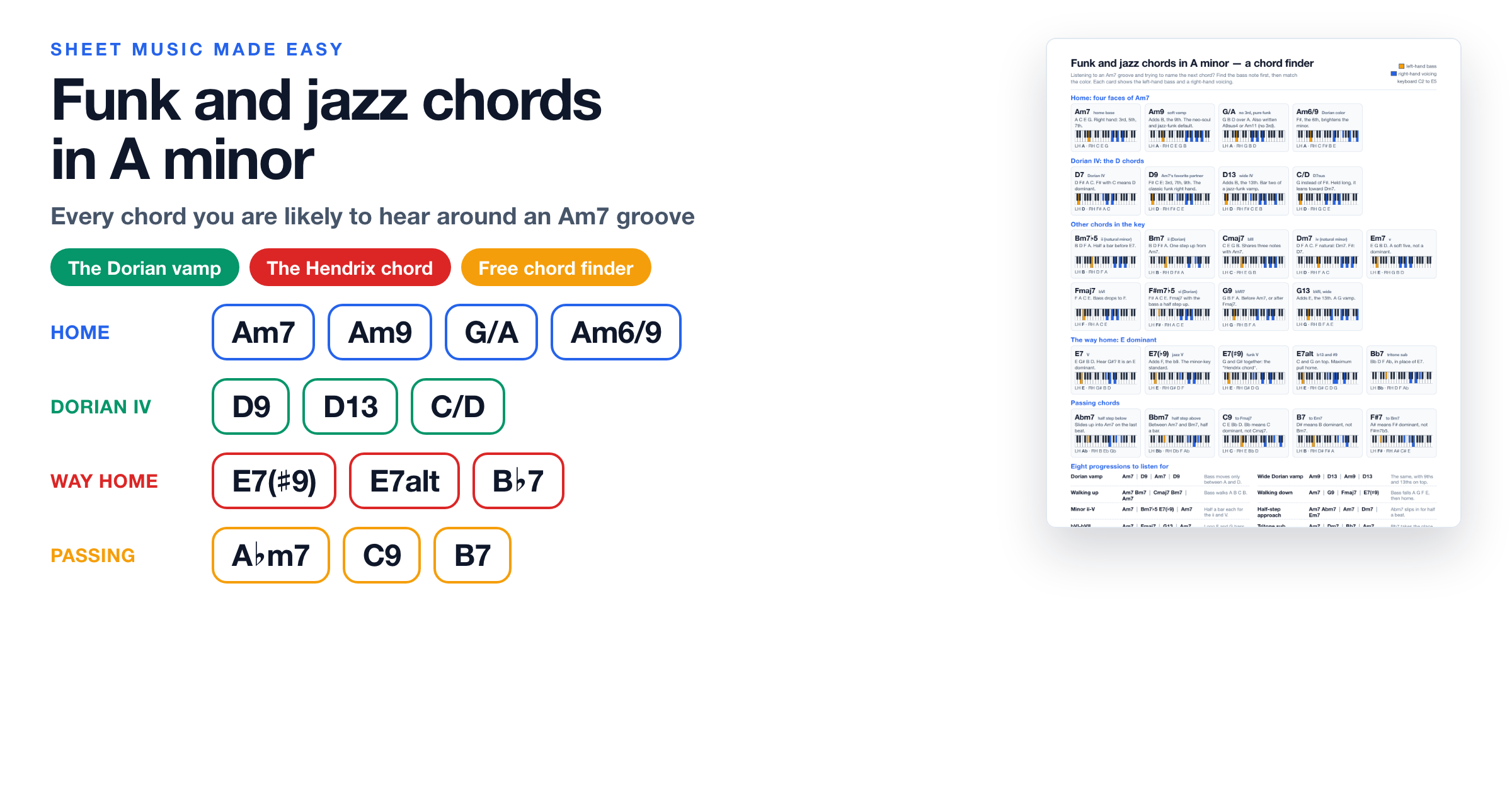
A funk or jazz groove in A minor uses a small, predictable set of chords. Learn the four colors of the home chord, the Dorian D chord that answers it, the E chords that lead home and a handful of passing chords, and you can name most of what you hear by ear. The free one-page chord finder below has all 27 with keyboard diagrams.
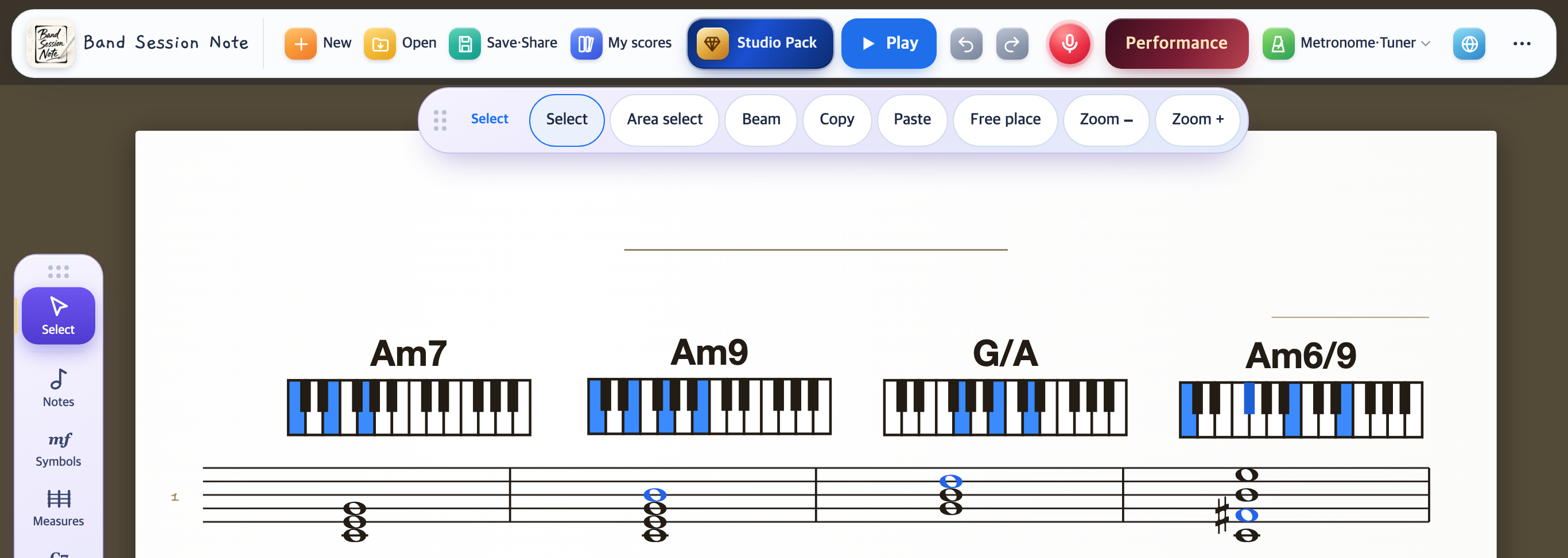
All the pictures show the right hand only, written in the treble clef. The left hand, or the bass player, plays the root: A under the Am chords, D under the D chords, E under the E chords.
Four faces of Am7
The same Am7 vamp can sound four different ways, depending on which notes the keyboard player puts on top. Blue marks the note that makes each one different.
The Dorian vamp: Am7 to D9
The most common move in A minor funk is two chords back and forth: Am7 and a D dominant chord. In the A Dorian mode the IV chord is major, D7, and its F# is the note that separates Dorian from plain natural minor. Minor, but not sad.
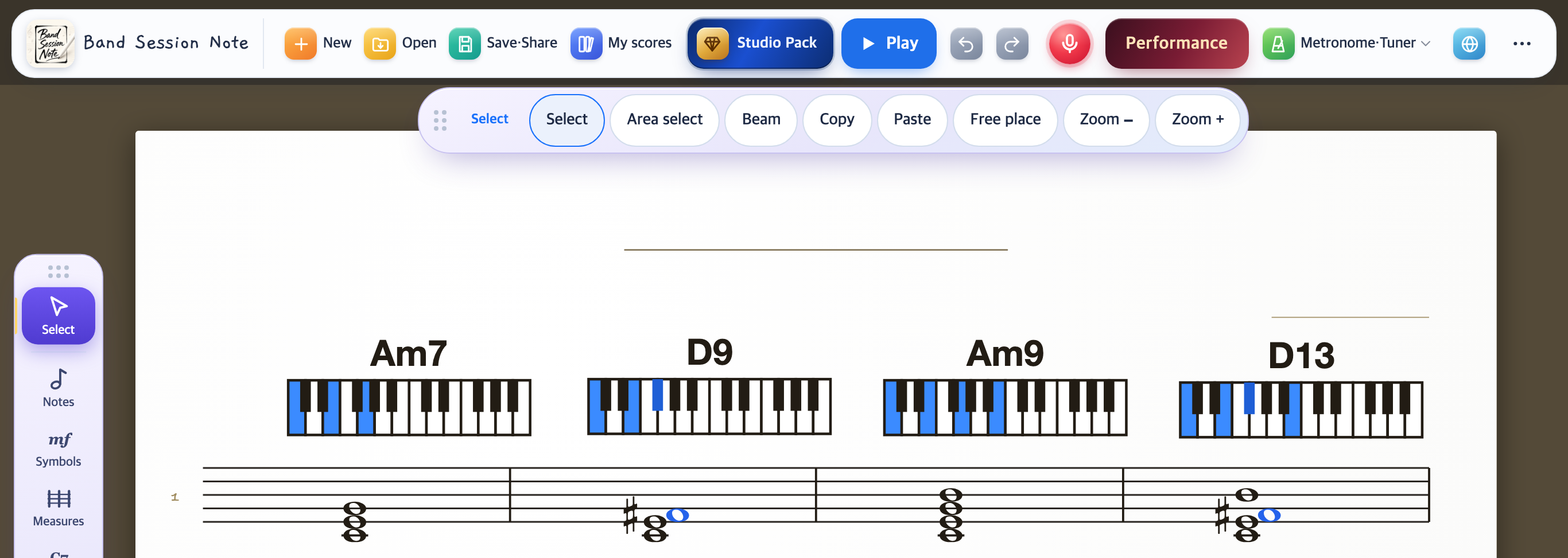
Look at what the right hand does: only one note moves. G in Am7 slides down a half step to F#, and C and E stay where they are. C E F# is the classic funk D9 voicing (7th, 9th and 3rd). Add B on top of both chords and the same move becomes Am9 to D13. When you hear the bass alternate between A and D and something brighter appears on the second chord, this is it.
Other chords in the key
When the bass leaves A and D, it usually lands on one of these. Three of them come in pairs: one from A natural minor, one from A Dorian. The single note that differs tells you which.
The way home: E dominant
The bar before the groove returns to Am7 is usually an E dominant chord. The give-away is G#: if you hear it, the chord is built on E. What sits on top decides the style.
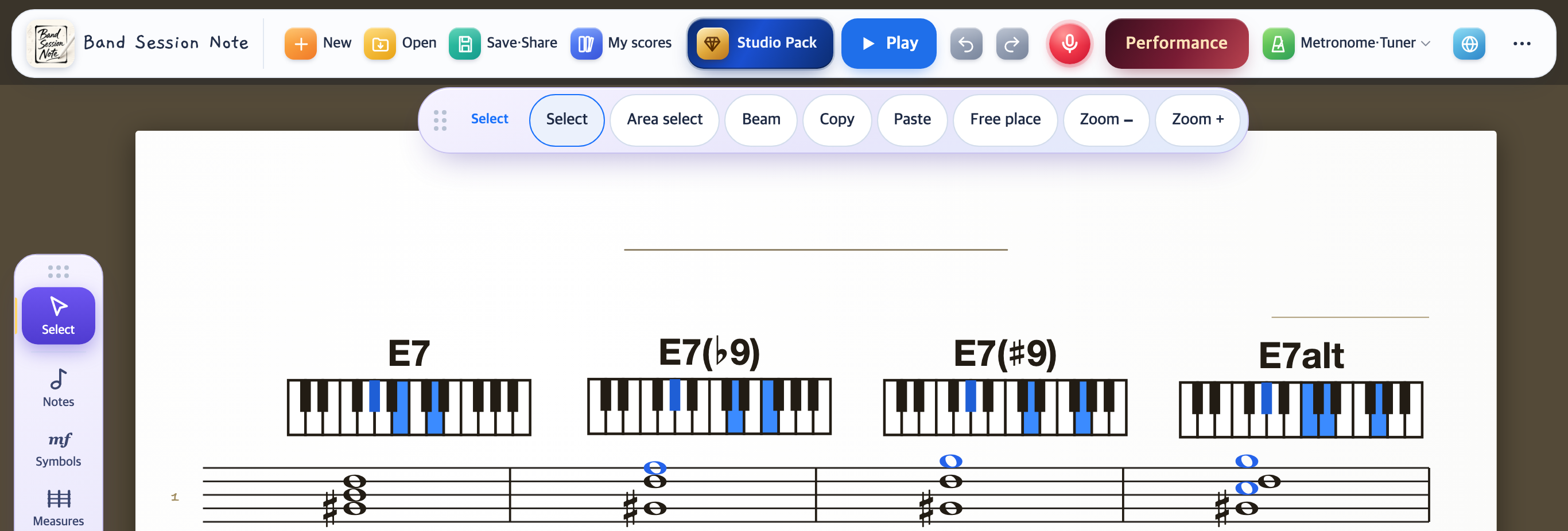
One more: B♭7 (B♭ D F A♭) can take the place of E7. It is the tritone substitute, and it shares its two most important notes with E7 (D and A♭, which sounds the same as G#). If the bass plays B♭ right before A, that is what you are hearing. The guide tone lines post shows why those two notes matter so much.
Passing chords
These last half a bar or a single beat on the way somewhere else.
A♭m7. Slides into Am7 from a half step below, usually on the last beat of the bar.
B♭m7. A half step above, between Am7 and Bm7.
C9, B7 and F#7. Each one leads into the chord a fifth below: C9 to Fmaj7, B7 to Em7, F#7 to Bm7. Listen for the note that does not belong to the key: B♭ in C9, D# in B7, A# in F#7.
Eight progressions to listen for
If the chords you hear follow one of these shapes, start your search there.
Finding them by ear
1. Find the bass note first. Hum the lowest note of each bar. It narrows 27 chords down to two or three.
2. Listen for the one note that decides. F or F# over D, G or G# over E, B♭ or B over C. Each pair splits two chords that otherwise sound alike.
3. Then the color. Plain 7th, 9th, 13th or a sus sound. If you are unsure, write the simpler name: Am7 is never wrong where Am9 is played.
4. Check the shape. Compare what you wrote with the eight progressions above.
Write the chords on a chart as you go. Our free blank lead sheet has room above every staff for chord names.
FAQ
What is a Dorian vamp?
A groove that stays on a minor chord and its major IV chord, such as Am7 and D7 or D9. The F# in the D chord is the raised 6th of the Dorian mode, which keeps the minor key from sounding dark.
Why is E7(♯9) called the Hendrix chord?
Jimi Hendrix made the 7♯9 sound famous in rock. It contains both the major 3rd and, written as a ♯9, the minor 3rd, which gives it a bluesy, unsettled edge that suits funk.
Is G/A the same as Am11?
Close. G/A has A, G, B and D: the root, 7th, 9th and 11th of A, with no 3rd. A full Am11 would add C. Without the C you will also see it written A9sus4. All three names point to the same open funk sound.
Does this work in other minor keys?
Yes. Move every chord by the same interval. In D minor, for example, the Dorian vamp becomes Dm7 to G9 and the way home becomes A7(♯9).
How do these connect to the voicing posts?
The right-hand shapes here are shell voicings with color notes added, and the Dorian vamp is the home of quartal voicings too.
Every example on this page was written in Band Session Note, the iPad notation app I make. The pictures are the app’s own screen.


Comments
Post a Comment