Rootless Voicings Explained: The A and B Forms Through Any ii–V–I (Free 12-Key PDF)
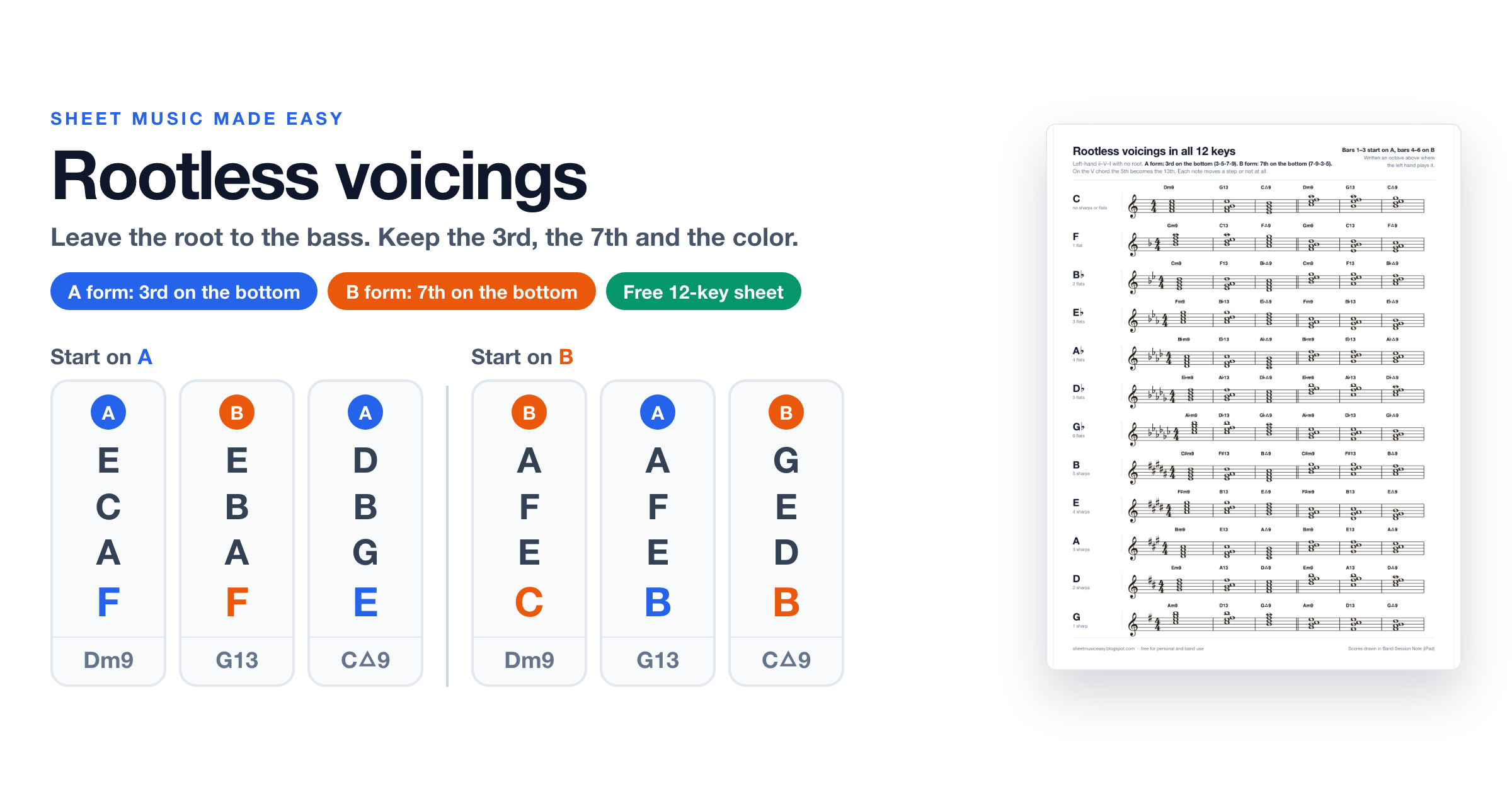
A rootless voicing leaves the root to the bass player and gives your left hand four better notes: the 3rd, the 7th and two colour tones. There are only two shapes to learn. The A form has the 3rd on the bottom, the B form has the 7th on the bottom. Switch between them through a ii–V–I and your hand barely moves. The free sheet below has both versions in all 12 keys.
What “rootless” means
In a band, the bass player is already playing the root. If your left hand plays it too, the two of you double the same note in the same low register, and the chord gets thick. A rootless voicing simply leaves it out.
That frees up a finger. The four notes you keep are the 3rd and the 7th, which tell the ear whether the chord is major, minor or dominant (the guide tones), plus two colour notes: the 9th, and the 5th or the 13th. If you know shell voicings (root, 3rd, 7th), this is the next step: drop the root, add the colour.
The A form and the B form
Take Dm9: D, F, A, C, E. Leave out the D and you have F, A, C, E. Stack them from the 3rd up and you get the A form. Start from the 7th instead and you get the B form: the same four notes, with the bottom pair moved to the top. The bottom note of each shape is blue.
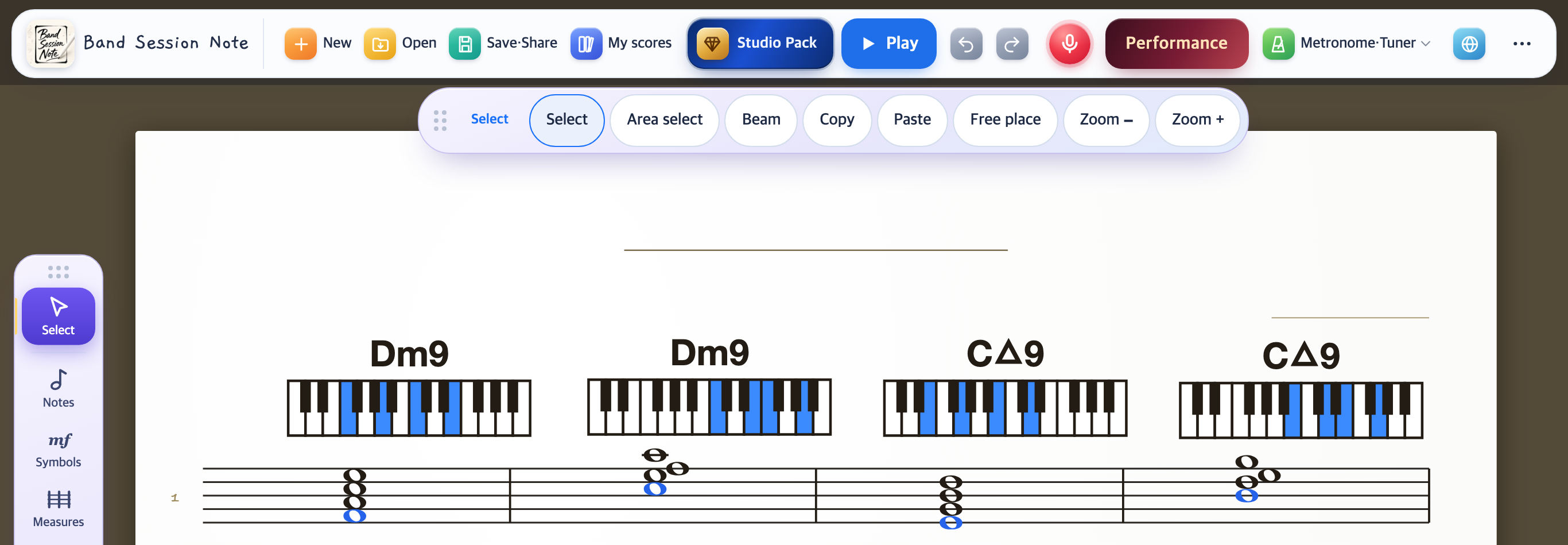
On a dominant chord, the 13th takes the place of the 5th. G13 without its root is B, E, F, A: the 3rd, 13th, 7th and 9th. The pianist and educator Mark Levine calls these two shapes the A and B voicings in his books, and many teachers use the same names.
ii–V–I starting on A
Here is the trick that makes these voicings worth learning. If the ii chord is an A form, the V chord is a B form and the I chord is an A form again. The blue notes are the only ones that moved.
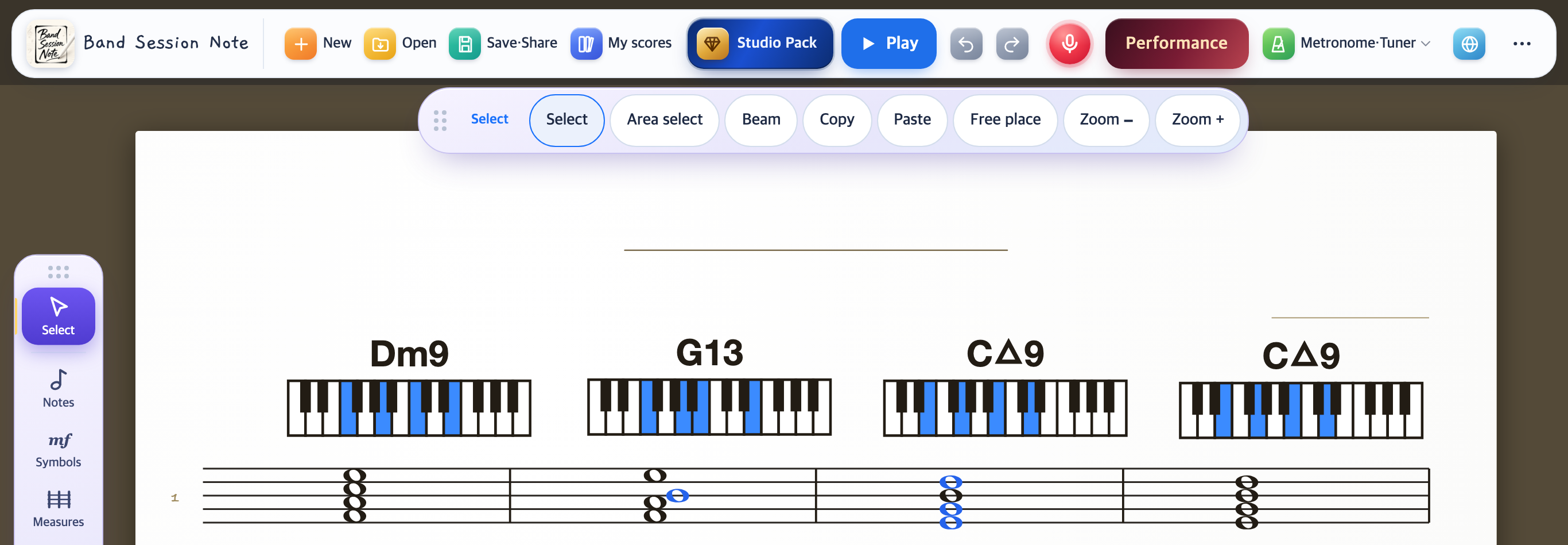
No note moves more than a whole step. That is what pianists mean by smooth voice leading, and it is the same 3rd-to-7th movement you see in a guide tone line, with two extra notes riding along.
ii–V–I starting on B
Start the ii chord on the B form and everything flips: B, then A, then B. It sits a little higher on the keyboard, which is useful when the A version would be too low.
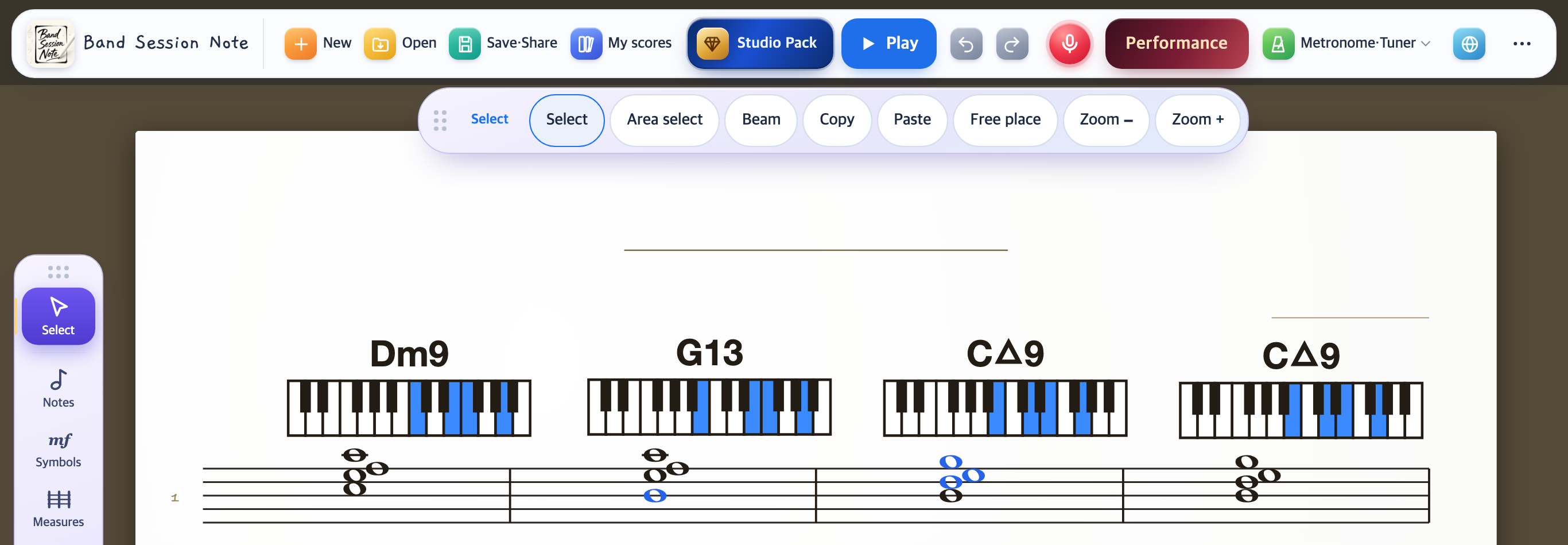
The movement is the same: on the way to G13 only the C drops to B, and on the way to C△9 the B holds while the other three step down. In real tunes you pick whichever start keeps your hand in the middle of the keyboard.
Where to play them
The pictures and the free sheet are written in treble clef so they are easy to read. Play them with your left hand one octave lower than written, around middle C.
Teachers give slightly different limits, but they agree on the idea: Levine suggests keeping your left little finger between the C below middle C and middle C, and the pianist and educator Earl MacDonald keeps the top note (the thumb) between middle C and the C above it. Lower than that the chord turns muddy, higher and it sounds thin. Played an octave down, every voicing on the free sheet stays between the C below middle C and the C above middle C.
Four common mistakes
1. Putting the root back in. With a bass player, the root in your left hand only gets in the way. Playing solo, put the root in the bass with your left hand and move the four notes to your right hand.
2. Using one form for every chord. All A forms through a ii–V–I makes your hand jump. Alternate A and B and it barely moves.
3. Playing too low. Four notes this close together turn to mud below the C under middle C.
4. Clashing with the melody on the I chord. If the melody sits on the root, the 7th of C△9 rubs against it a half step away. Many pianists swap the 7th for the 6th there: C6/9 is A, D, E, G or E, G, A, D.
How to practise it
1. Print the sheet. Play the C line with your left hand, an octave lower than written. Say the chord names out loud.
2. Play the root of each chord with your right hand at the same time, so your ear hears the full chord. Then take the root away.
3. Work down the page. The keys go around the circle of fourths (C, F, B♭, E♭ and on), so each line starts a fourth higher than the last.
4. Take a tune you know with a ii–V–I and comp through it with these shapes while a backing track or a friend plays the bass.
FAQ
What is a rootless voicing?
A chord played without its root, usually four notes: the 3rd and 7th plus the 9th and the 5th (or the 13th on a dominant chord). It is the standard left-hand comping sound in jazz piano.
What are A and B voicings?
The two ways to stack those four notes. A has the 3rd on the bottom (3-5-7-9), B has the 7th on the bottom (7-9-3-5). Alternating them through a ii–V–I keeps every note within a step of where it was.
Who started playing them?
Pianists such as Red Garland, Wynton Kelly, Ahmad Jamal and Bill Evans were using them in the mid to late 1950s. Bill Evans is the name most often attached to them, because he used them so consistently.
Can I play rootless voicings without a bass player?
Yes. Play the root low in your left hand and the four-note shape in your right. The shapes are the same, they just change hands.
How is this different from shell voicings?
Shell voicings keep the root and play three notes. Rootless voicings drop the root and play four, adding colour. Guitarists usually get a similar sound from drop 2 voicings, because four notes this close together are hard to finger.
Every example on this page was written in Band Session Note, the iPad notation app I make. The pictures are the app’s own screen.


Comments
Post a Comment