Tritone Substitution Explained: Why D♭7 Can Replace G7 (Free 12-Key PDF)
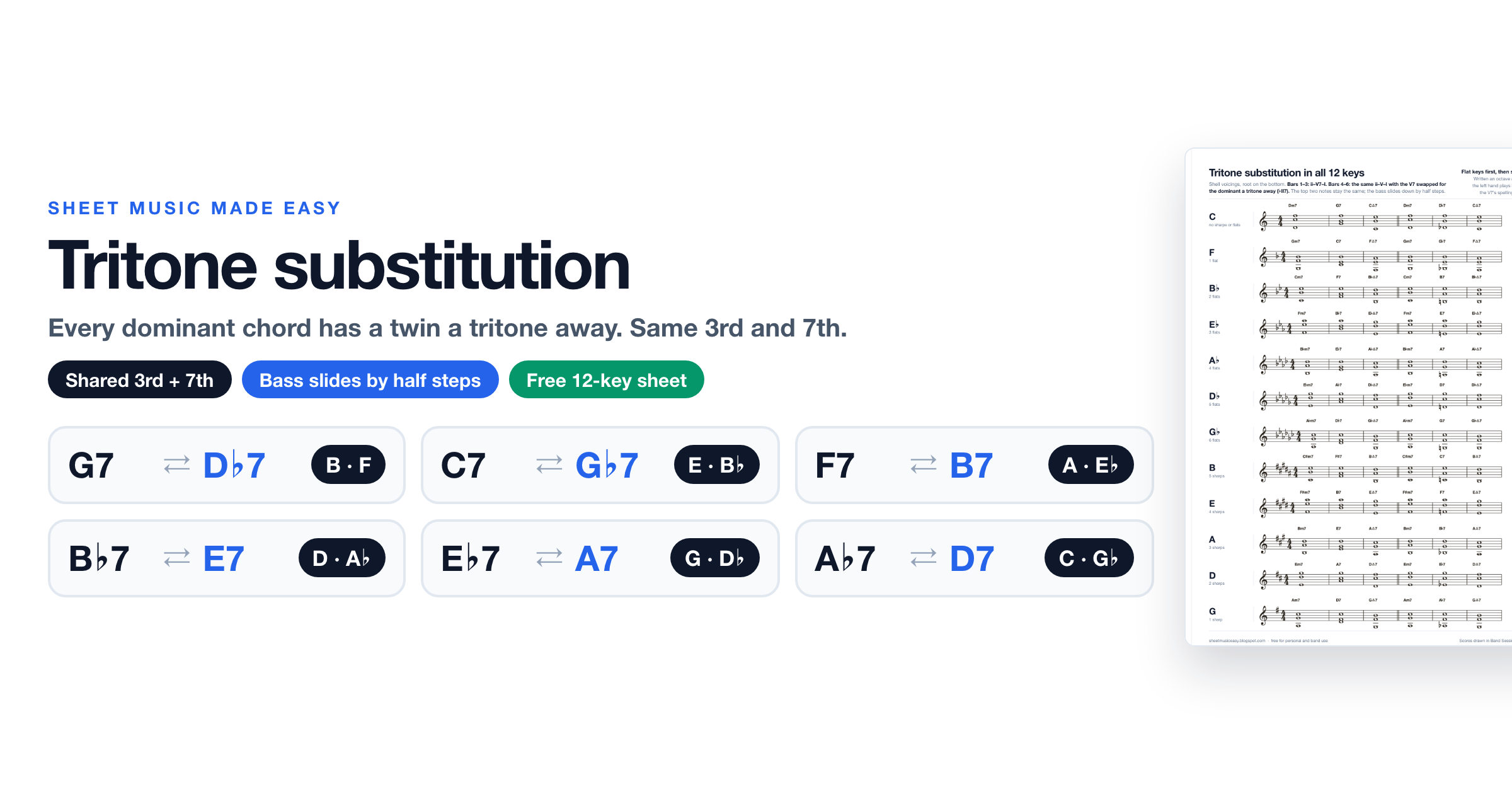
A tritone substitution swaps a dominant seventh chord for the dominant seventh whose root is a tritone away: D♭7 instead of G7 in the key of C. The two chords share the same 3rd and 7th, so the substitute still pulls home to C, but the bass now slides down by half steps instead of jumping. The free sheet below has the swap in all 12 keys.
Why it works
G7 is G, B, D, F. Its 3rd and 7th, B and F, are a tritone apart, and that tense pair is what wants to resolve to C. These are the guide tones of the chord.
Now look at D♭7: D♭, F, A♭, C♭. Its 3rd is F and its 7th is C♭, which is the same key as B. Same two notes, roles swapped. So D♭7 can do G7’s job. Every dominant chord has a partner like this, and here are two pairs. The shared 3rd and 7th are in blue.
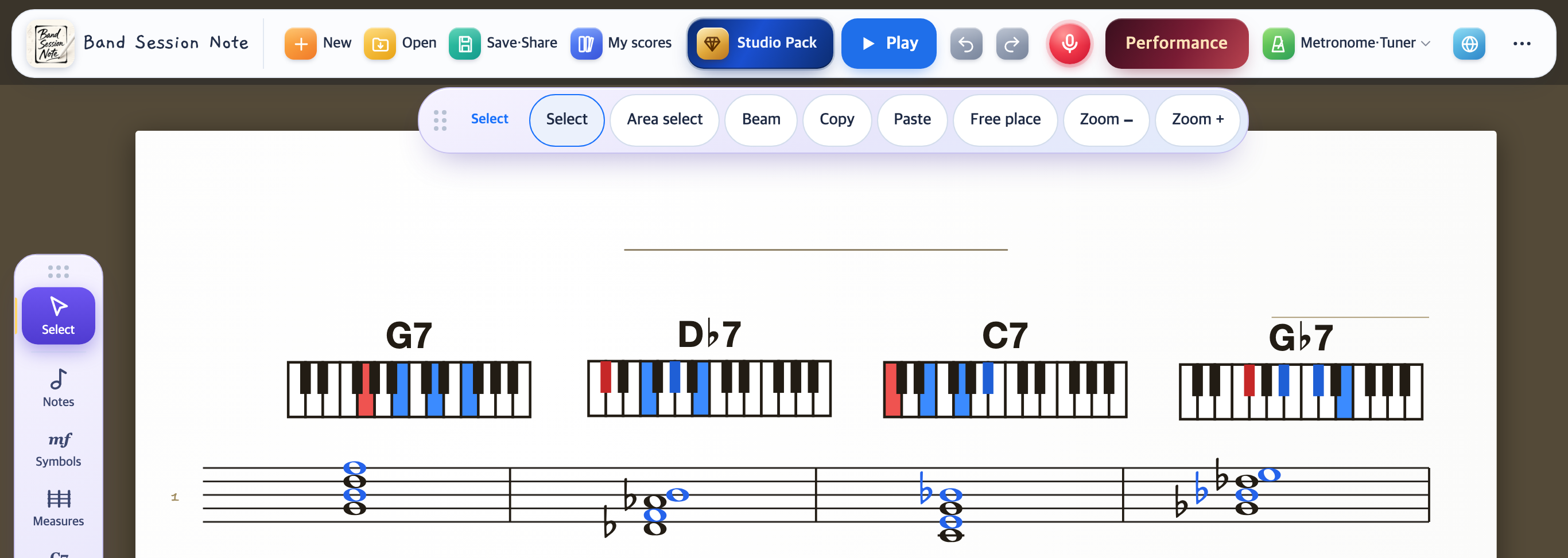
The second pair, C7 and G♭7, shares E and B♭, the same left hand we used for upper structure triads. On the keyboard diagrams, red marks the root.
In a ii–V–I
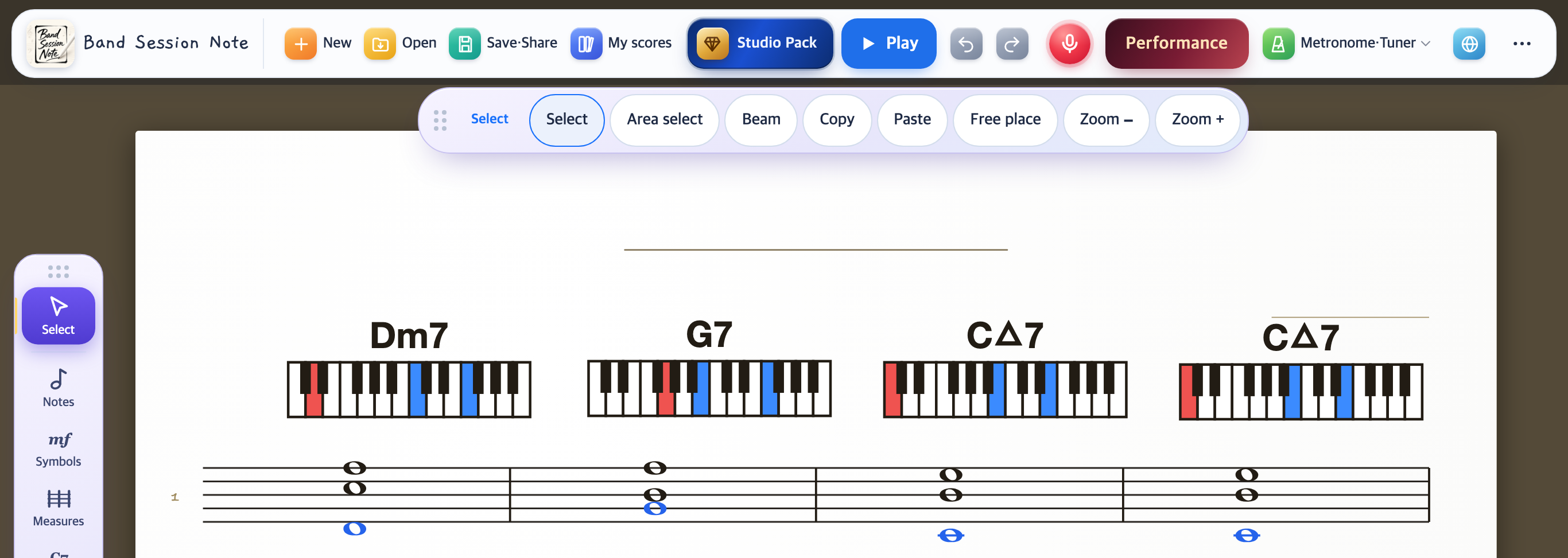
Here is a plain ii–V–I in C with shell voicings: root on the bottom, then the 3rd and 7th. The roots are in blue. Watch them jump: D, up to G, down to C.
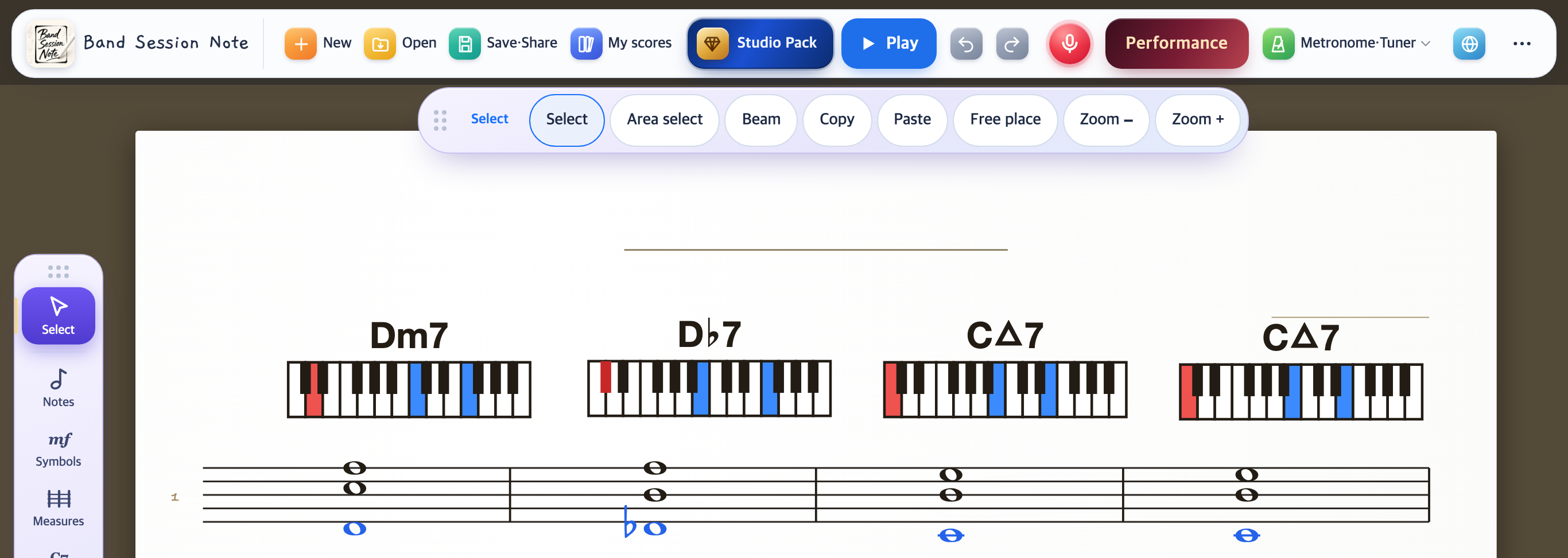
Now swap G7 for D♭7. Everything else stays where it was.
The six pairs
Twelve dominant chords make six pairs. To find a partner, go up or down a tritone (six half steps) from the root. The two notes in the last column are the shared 3rd and 7th.
| Chord | Tritone sub | Shared 3rd and 7th |
|---|---|---|
| G7 | D♭7 | B and F |
| C7 | G♭7 | E and B♭ |
| F7 | B7 | A and E♭ |
| B♭7 | E7 | D and A♭ |
| E♭7 | A7 | G and D♭ |
| A♭7 | D7 | C and G♭ |
It works both ways: D♭7 is the tritone sub for G7, and G7 is the tritone sub for D♭7.
What it adds to the sound
Play D♭7 while the bass player stays on G and listen to what the extra notes are against G: D♭ is the ♭5 (or ♯11) and A♭ is the ♭9. So the sub is close to a G7(♭9♯11), a darker, altered dominant. In fact D♭, F and A♭ are the ♭V upper structure triad over G7 from the last post: the tritone sub is that triad with one more note.
When to use it
Check the melody before you swap. A D in the melody is the 5th of G7, but over D♭7 it becomes the ♭9, a much sharper sound. Sometimes that is exactly what you want, sometimes it is not.
Four common mistakes
1. Trying it on chords that are not dominant sevenths. In Dm7 and C△7 the 3rd and 7th are a perfect 5th apart, not a tritone, so there is no partner chord to swap in.
2. Getting stuck on C♭. Call the chord D♭7, then play and write its 7th as B if that is easier to read.
3. Forgetting the melody. A melody note that sounded calm over G7 can rub against D♭7. Play the melody with the new chord before you commit to it.
4. Using it on every dominant. The half-step bass is a nice surprise. Save it for the spots where you want that slide, such as the last ii–V of a tune or a turnaround.
How to practise it
1. Print the sheet. Play the C line with your left hand an octave lower than written: bars 1–3, then bars 4–6. Listen to the bass in each half.
2. Hold the top two notes of G7 and move only the bottom note from G to D♭. You are hearing the same guide tones over two different roots.
3. Go down the page. The keys move around the circle of fourths (C, F, B♭, E♭ and on), and each line has one accidental to watch: the root of the sub chord.
4. Take a 12-bar blues you know and swap the chord in bar 4 for its tritone sub, as described above.
FAQ
What is a tritone substitution?
Replacing a dominant seventh chord with the dominant seventh a tritone away, such as D♭7 for G7. The two chords share their 3rd and 7th, so the substitute leads to the same chord.
What is the tritone sub for G7?
D♭7. Count six half steps from G and you land on D♭. The table above lists all six pairs.
Why is it called a tritone substitution?
Two reasons that happen to match: the roots of the two chords are a tritone apart, and the shared 3rd and 7th form a tritone.
Does it work in minor keys?
Yes. In C minor, Dm7♭5, D♭7, Cm gives the same half-step bass line.
Who used it first?
It became part of the bebop sound of the 1940s in the playing of Dizzy Gillespie and Charlie Parker, and Duke Ellington and Art Tatum used it too. Classical music has the same chord under another name: the augmented sixth chord.
Every example on this page was written in Band Session Note, the iPad notation app I make. The pictures are the app’s own screen.


Comments
Post a Comment