Secondary Dominants Explained: The V7 of Every Chord in a Key (Free Chart PDF)
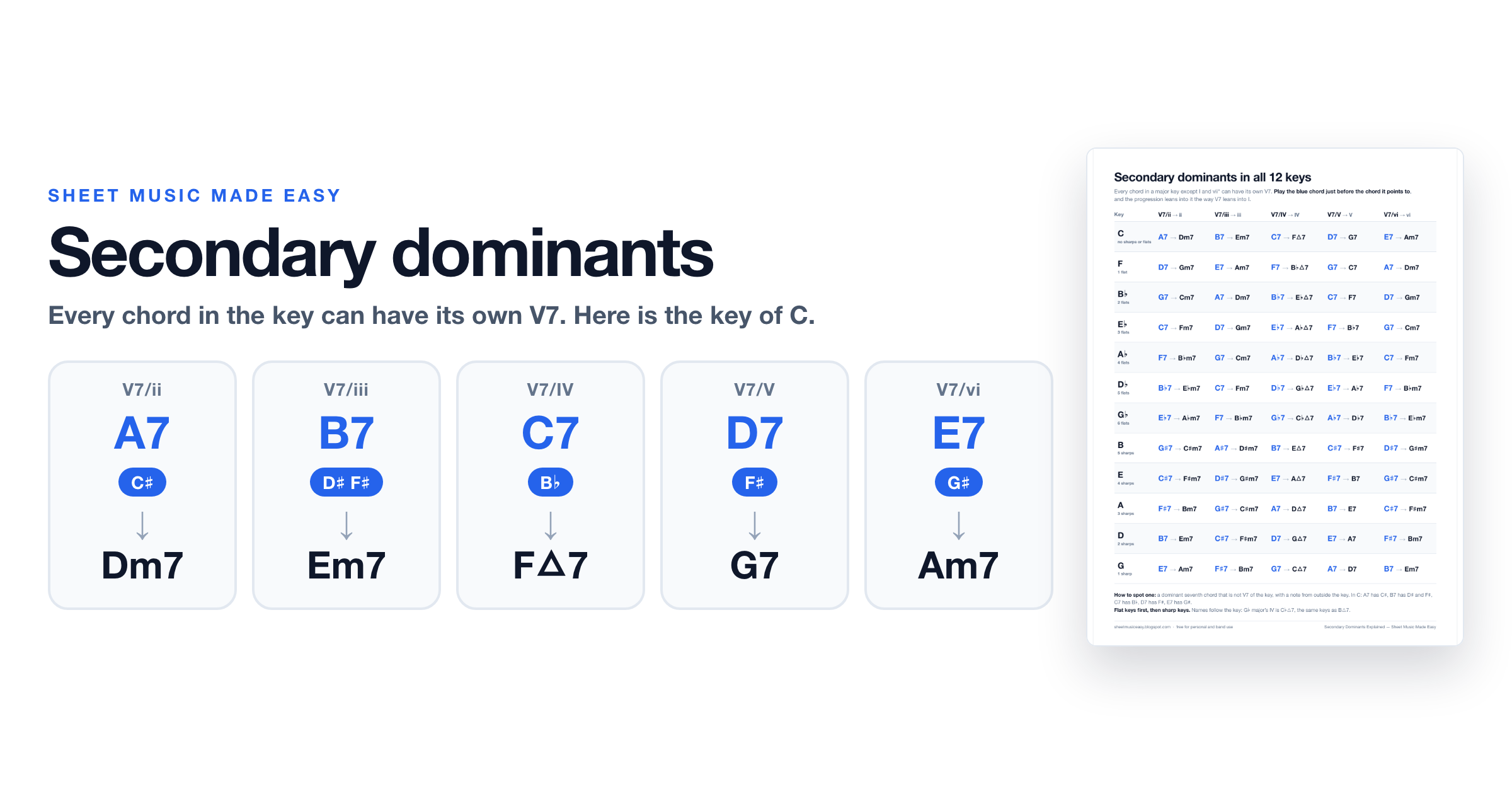
A secondary dominant is the V7 of a chord other than the tonic. In C major, A7 leads to Dm7, so A7 is “V7 of ii”, written V7/ii. A note from outside the key gives it away, and that note pulls toward the chord it is aiming at. The free chart below lists all five secondary dominants in every major key.
What it is
In C major, G7 is the V7. It leads home to C. Now pretend for a moment that Dm7 is home. What would its V7 be? Count five letters up from D and you get A, so the answer is A7: A, C♯, E, G. Play A7 right before Dm7 and the Dm7 sounds like a little arrival, the way C does after G7.
That is all a secondary dominant is: a V7 borrowed for a chord other than I. The name tells you which chord: V7/ii (“five-seven of two”) is the V7 of the ii chord. Theory books call the effect tonicizing the chord: it becomes a short-lived home, but the key does not change.
How to spot one
Compare a chord that belongs to the key with the secondary dominant on the same root. Am7 is the vi chord in C. A7 is the same chord with one note raised: C becomes C♯. Em7 and E7 work the same way: G becomes G♯. The raised note is in blue.
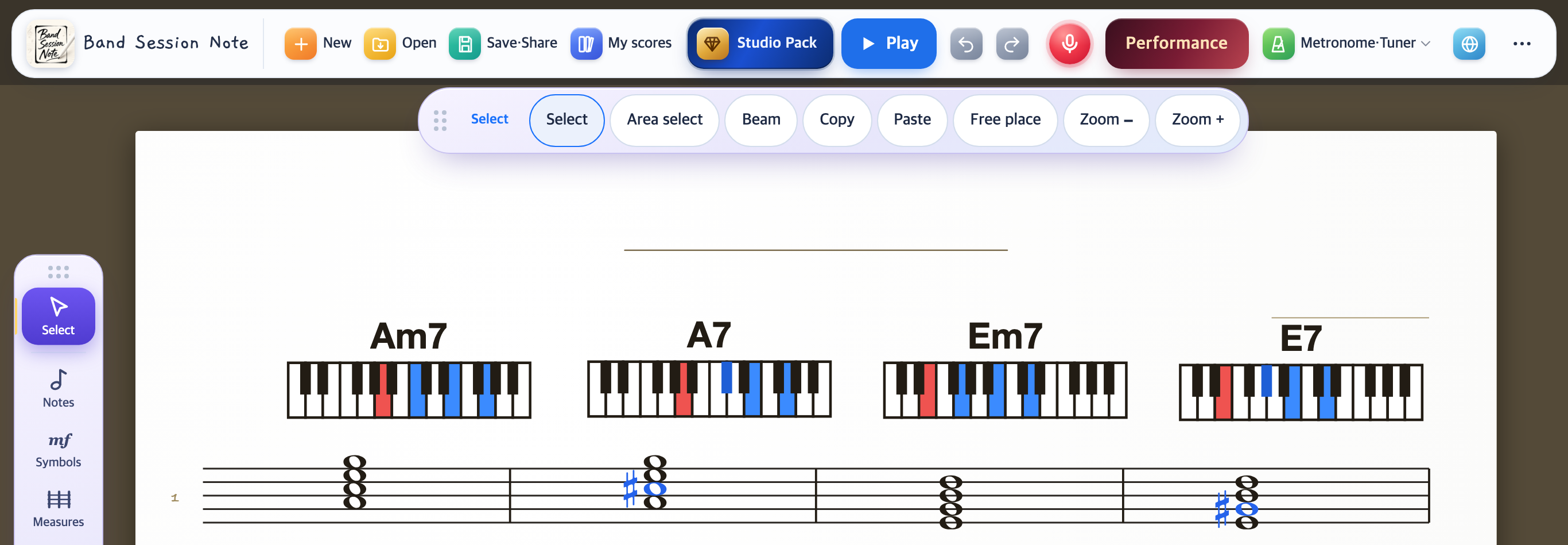
So the quick test is: a dominant seventh chord that is not the V7 of the key, with a note from outside the key. Usually that note is the raised 3rd. Two exceptions are worth knowing: C7 (V7/IV) gets its outside note from the 7th, B♭, and B7 (V7/iii) has two, D♯ and F♯.
Where it goes
The raised note is not random. C♯ sits a half step below D, the root of Dm7, and G♯ sits a half step below A, the root of Am7. Each one is a leading tone that wants to rise into its target. In the picture, each target chord is written so that its root lands right above the blue note.
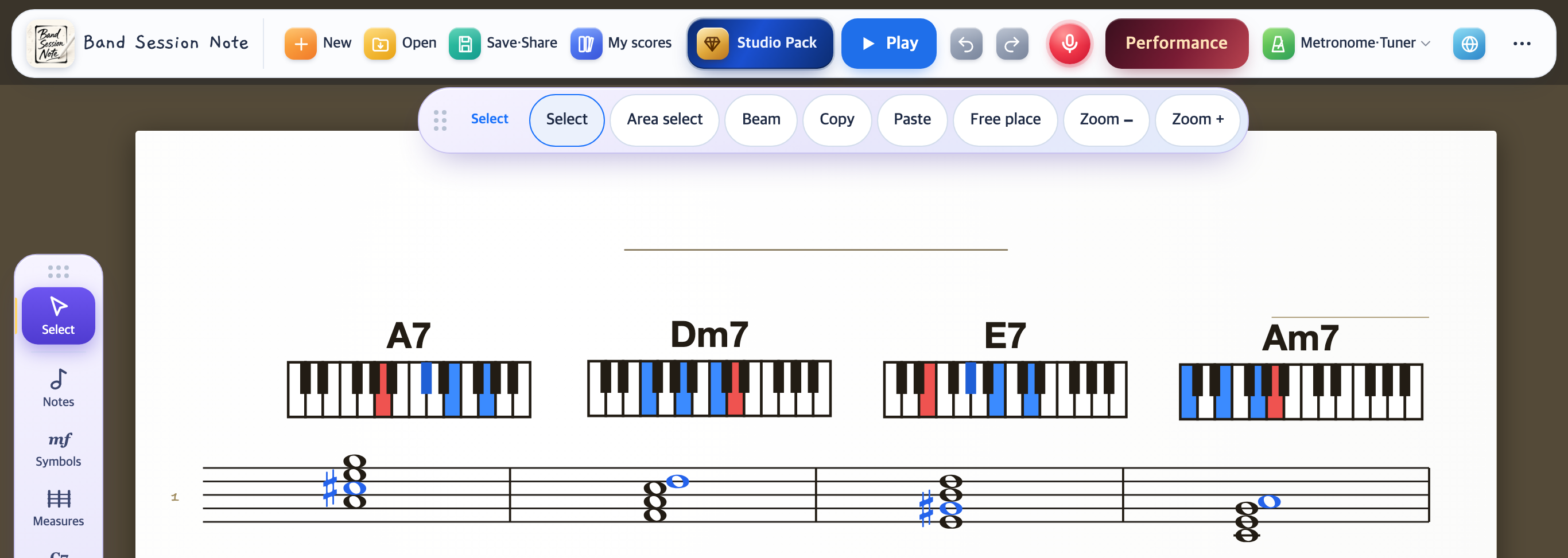
The 7th of the secondary dominant usually steps down: the G of A7 falls to the F of Dm7, and the D of E7 falls to the C of Am7. In jazz voicings the raised 3rd often moves down a half step instead, to the 7th of the next chord, which is the same movement you see in a guide tone line. Either way, the ear hears the pull.
The five in C
Any major or minor chord in the key can have its own V7. In C major that gives five:
| Name | Chord | Goes to | Note from outside the key |
|---|---|---|---|
| V7/ii | A7 | Dm7 | C♯ |
| V7/iii | B7 | Em7 | D♯ and F♯ |
| V7/IV | C7 | F△7 | B♭ |
| V7/V | D7 | G7 | F♯ |
| V7/vi | E7 | Am7 | G♯ |
Two chords are left out. The V7 of I is just G7, the normal dominant. And the vii chord, Bm7♭5, is a diminished chord, which does not feel like a place to land, so it is not usually given its own V7.
In a progression
The most common place to meet one is the turnaround I–vi–ii–V. Swap the vi chord, Am7, for A7 and you get I–VI7–ii–V: C△7, A7, Dm7, G7. One sharp, and the whole line leans forward into the ii chord.
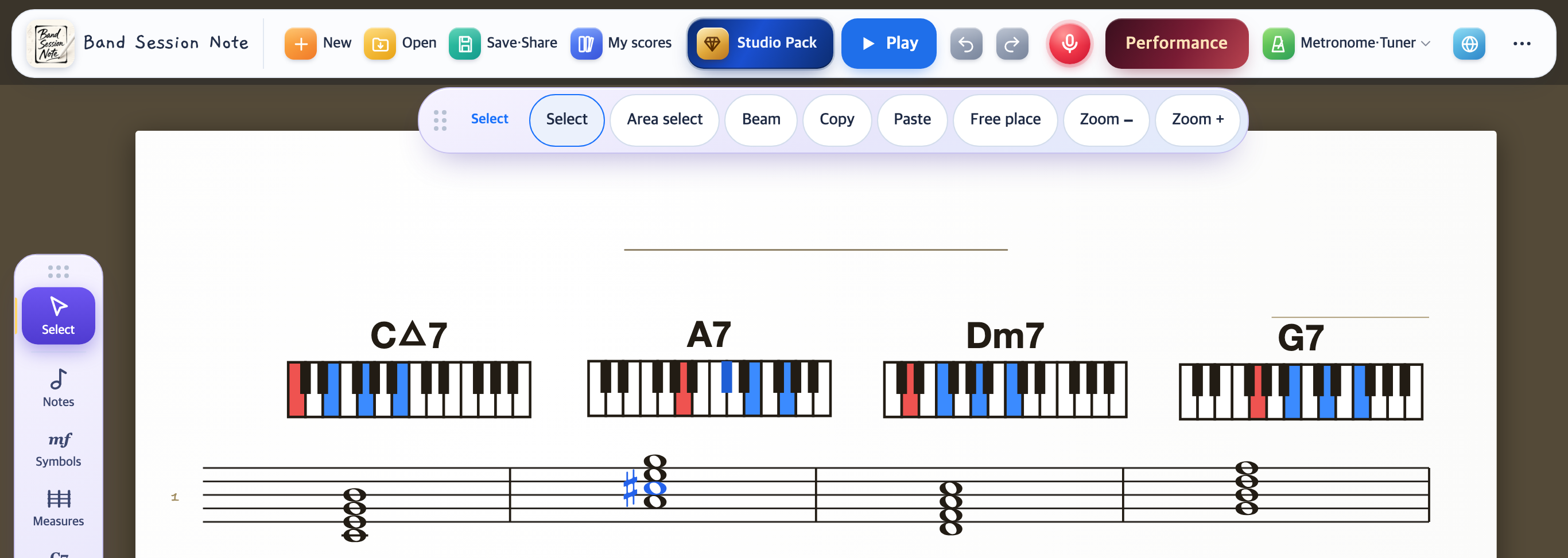
Go further and make the ii chord a dominant too: C△7, A7, D7, G7. Now A7, D7 and G7 are each the V7 of the chord after them, a chain of dominants that walks down by fifths back home. The jazz standard “Sweet Georgia Brown” opens with a chain like this. And because every one of these is a dominant seventh, each can also be swapped for its tritone substitution: A7 to Dm7 can become E♭7 to Dm7.
Four common mistakes
1. Calling every dominant chord a secondary dominant. It only counts when it moves to its target, the chord a fifth below. In a blues in C, the C7 on the first bar is the home chord, not a V7 of anything.
2. Dropping the accidental. Reading A7 and playing Am7 loses the whole effect. The C♯ is the reason the chord is there.
3. Leaving the leading tone hanging. In a written part, the raised note should step to the next chord (C♯ up to D, or down to C in a jazz voicing), not leap away.
4. Putting one before every chord. They work best on the chord you want to point at. Use one or two in a phrase and the arrival on that chord stands out.
How to practise it
1. Print the chart. Play the C line pair by pair: A7 to Dm7, B7 to Em7 and so on. Listen for the moment of arrival.
2. Play only the outside note and where it goes: C♯ to D, G♯ to A, F♯ to G. That half step is the sound of a secondary dominant.
3. Take I–vi–ii–V in C and swap one chord at a time: first Am7 for A7, then Dm7 for D7.
4. Go down the chart. The keys are listed flat keys first, then sharp keys, so you can pick the keys your band plays in.
FAQ
What is a secondary dominant?
The V7 of a chord in the key other than I. It leads to that chord the way V7 leads to I, for example A7 to Dm7 in C major.
How do you write it?
With a slash: V7/ii means the V7 of ii. In a chord chart you simply see the chord name, A7, and the accidental tells you it is not from the key.
Which chords can have a secondary dominant?
In a major key: ii, iii, IV, V and vi. The V7 of I is just the normal V7, and the diminished vii chord is not usually given one.
Do secondary dominants work in minor keys?
Yes. In A minor, A7 to Dm is the V7 of iv, and the C♯ pulls up to D just the same.
Is a secondary dominant a key change?
Not usually. It points at one chord for a moment and the music stays in the same key. When a new key settles in for a while, that is a modulation.
Every example on this page was written in Band Session Note, the iPad notation app I make. The pictures are the app’s own screen.


Comments
Post a Comment