Diminished Passing Chords Explained: How C♯°7 Connects C and Dm7 (Free Chart PDF)
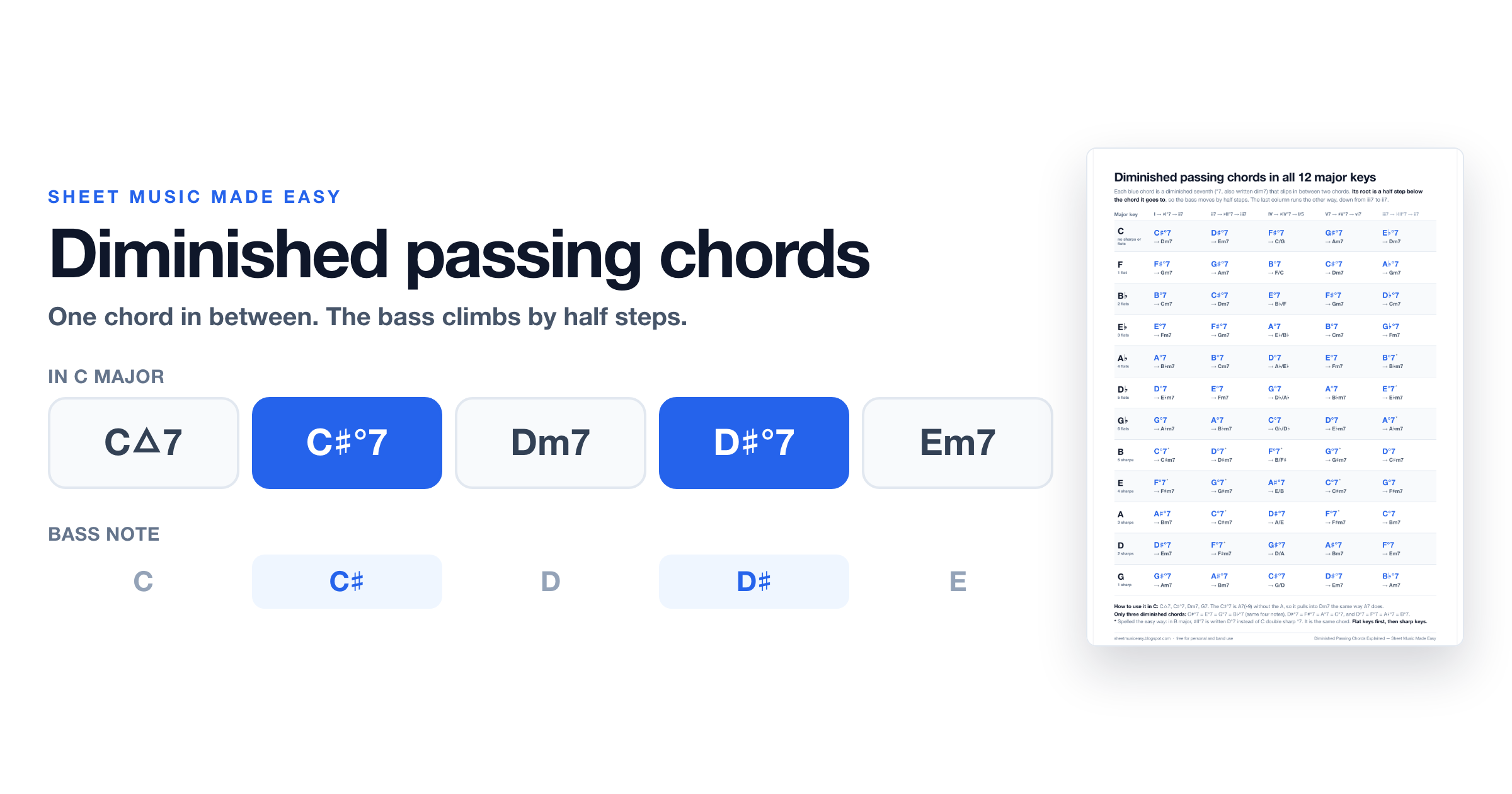
A diminished passing chord is a diminished seventh chord slipped in between two chords whose roots are a whole step apart. Its root sits a half step below the chord it goes to, so in C you play C△7, C♯°7, Dm7 and the bass climbs C, C♯, D. You hear it all through jazz standards and gospel, and it only lasts a beat or two. The free chart below lists the five most useful spots in all 12 major keys.
What it is
A diminished seventh chord is four notes stacked in minor thirds: C♯°7 is C♯, E, G and B♭. You will see it written C♯°7 or C♯dim7. Both mean the same chord.
A passing chord is a chord that is only there to get you from one place to the next. Put the two ideas together and you get a short diminished chord between two chords a whole step apart, such as C and Dm7. It fills the gap with a half step, so the bass walks instead of jumping, and the ear hears a little lift into the next chord.
One chord in between
Here is the classic move in C: C△7, C♯°7, Dm7, G7. The bottom note rises C, C♯, D. E and G stay where they are, and the top note dips from B to B♭ before it lands on C. The two notes from outside the key are in blue.
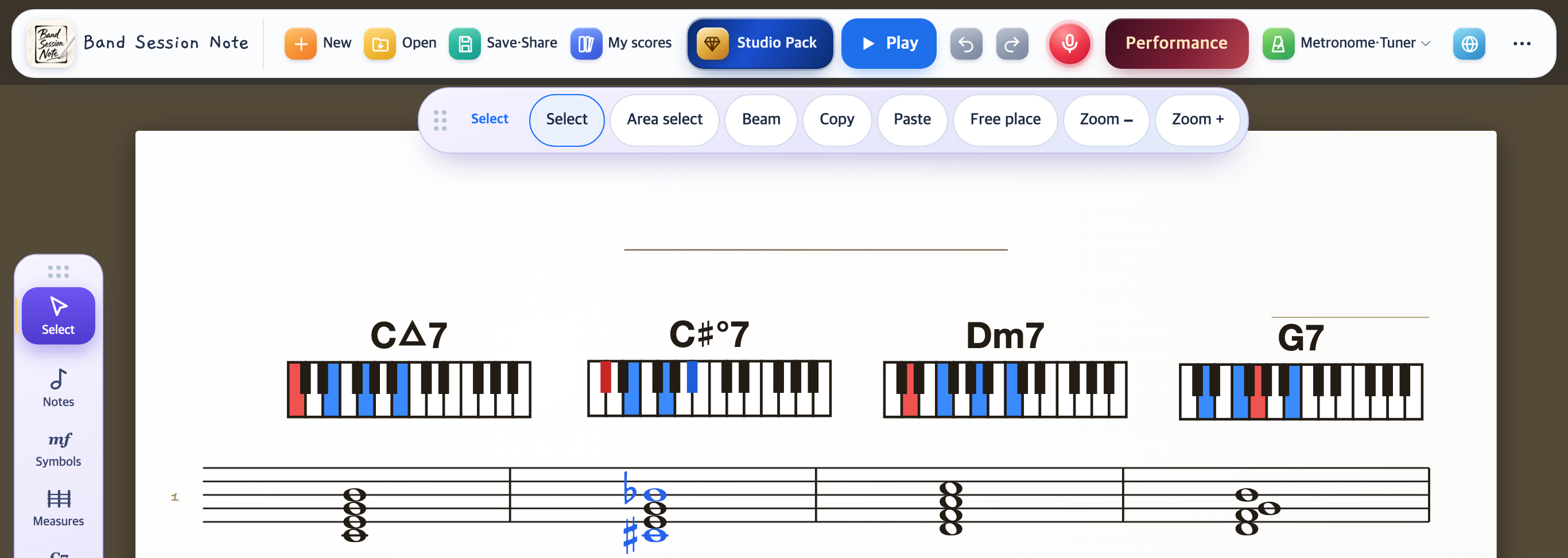
The diminished chord usually gets a beat or two, not a whole bar. In a bar of C that turns into Dm7, play C for the first half and C♯°7 for the second.
Why it works
C♯°7 is a dominant chord in disguise. Start with A7, the secondary dominant that leads to Dm. Add B♭ on top and you have A7(♭9). Now take away the A: the four notes left, C♯, E, G and B♭, are C♯°7. The blue notes below are those four.
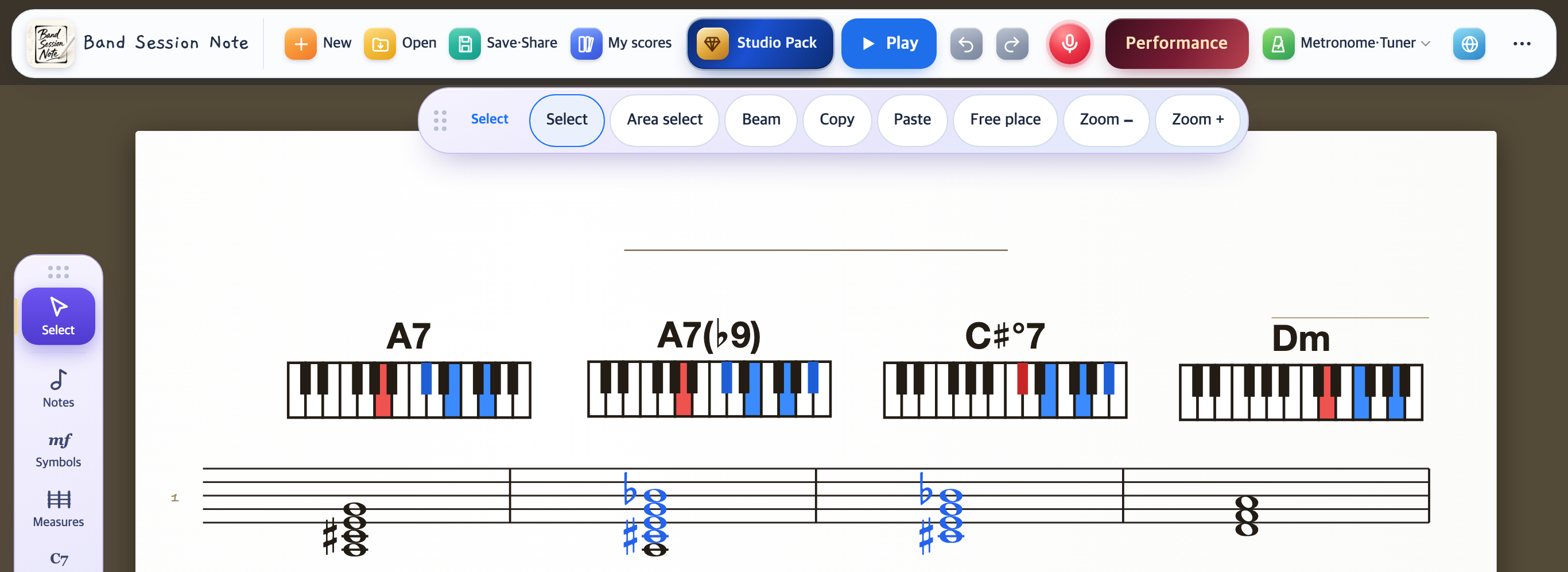
That is why it pulls so hard into Dm7. C♯ is a half step below D and wants to go up. B♭ is a half step above A and wants to come down. Theory books call it vii°7 of ii, the leading-tone chord of the chord that follows.
Only three diminished chords
Every note in a diminished seventh is a minor third from the next, all the way round. Play the chord from any of its notes and you get the same four notes again. So there are only three different diminished seventh chords:
| Same four notes | Names you will see |
|---|---|
| C♯, E, G, B♭ | C♯°7 = E°7 = G°7 = B♭°7 |
| D♯, F♯, A, C | D♯°7 = F♯°7 = A°7 = C°7 |
| D, F, A♭, B | D°7 = F°7 = A♭°7 = B°7 |
Learn three shapes and you can play every diminished chord on the chart. The name tells you which note the bass should play.
Where to use them
A favourite in gospel and older jazz is IV, ♯IV°7, then I with the 5th in the bass: F, F♯°7, C/G, G7 in C. The bass climbs F, F♯, G, and the chord on G sets up the way home.
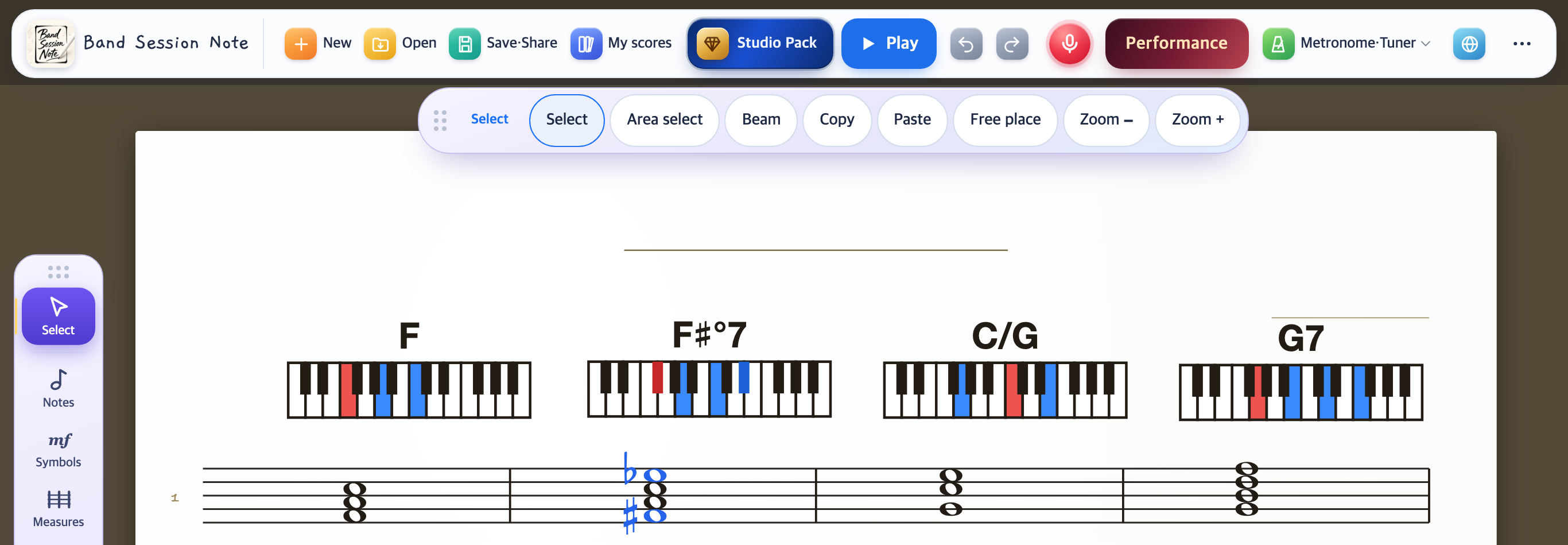
The other spots on the chart work the same way. Find two chords a whole step apart and put a diminished chord on the half step between them:
Four common mistakes
1. The wrong root. Build the diminished chord a half step below the chord you are going to: C♯°7 into Dm7, not D°7. On the way down, it is a half step below the chord you are leaving.
2. Mixing up °7 and m7♭5. C♯°7 has B♭. C♯m7♭5, the half-diminished chord, has B. The passing chord in this post is the full diminished seventh.
3. Stopping on it. A diminished chord sounds unfinished on its own. Keep it short and always move on to the next chord.
4. Clashing with the melody. In a slow ballad a passing diminished chord can rub against a held melody note. Check the tune first, or save the move for a bar where the melody moves too.
How to practise it
1. Play C△7, C♯°7, Dm7, G7 slowly with the voicing in the picture and listen to the bass step up.
2. Keep climbing: C△7, C♯°7, Dm7, D♯°7, Em7. Five chords, five bass notes a half step apart.
3. Learn the three diminished shapes from the table, then name each one four ways.
4. Print the chart and add one passing chord to a tune your band already plays.
FAQ
What is a diminished passing chord?
A diminished seventh chord placed between two chords whose roots are a whole step apart. Its root is a half step below the next chord, like C♯°7 between C and Dm7.
Why does it sound good?
It is the dominant of the next chord without its root. C♯°7 is A7(♭9) minus the A, so it pulls into Dm7 the same way A7 does.
How many diminished seventh chords are there?
Three. Each one has four names, because any of its notes can be the root: C♯°7, E°7, G°7 and B♭°7 are the same four notes.
Is °7 the same as dim7?
Yes. Both mean a diminished seventh chord. The half-diminished chord is written ø7 or m7♭5 and is a different chord.
Where does ♯IV°7 go?
Up to the chord on the 5th of the key. In C, F♯°7 goes to C/G or straight to G7, which is why IV, ♯IV°7, V7 is a standard move in traditional jazz.
Every example on this page was written in Band Session Note, the iPad notation app I make. The pictures are the app’s own screen.


Comments
Post a Comment