Block Chords Explained: Four-Way Close, Locked Hands and the Sixth-Diminished Scale (Free 12-Key PDF)
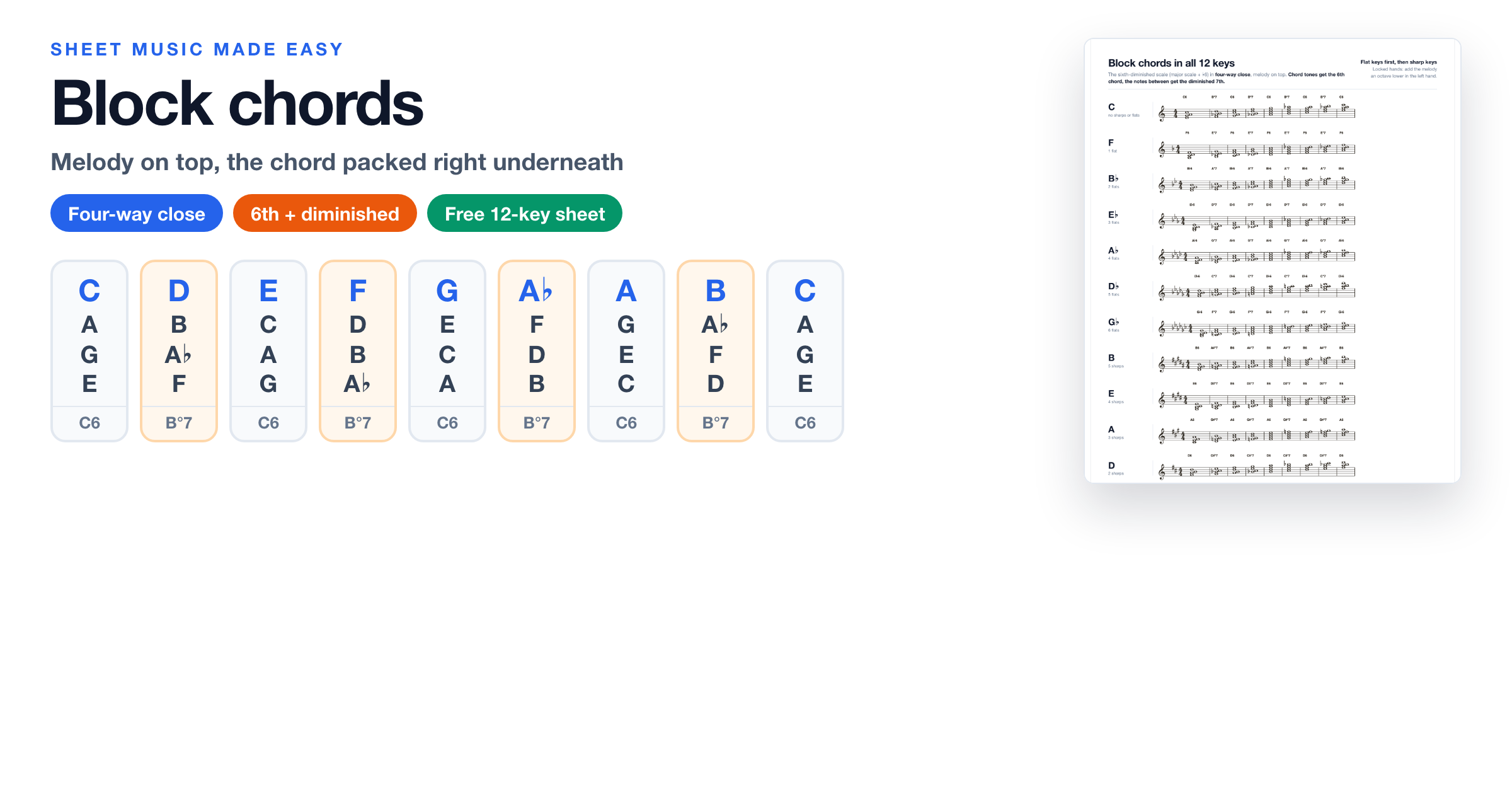
Block chords put a full chord under every single melody note. In four-way close, the melody sits on top and the other three chord tones are packed directly underneath it, all inside one octave. Melody notes that are not in the chord get a diminished seventh chord instead. Double the melody an octave lower and you have the locked-hands sound. The free sheet below has the whole idea in all 12 keys.
Build one block chord
Start with a C6 chord: C, E, G and A. Pick a melody note from it and put that note on top. Then stack the other three notes directly underneath, as close together as they will go. That is four-way close. The melody note is in blue.
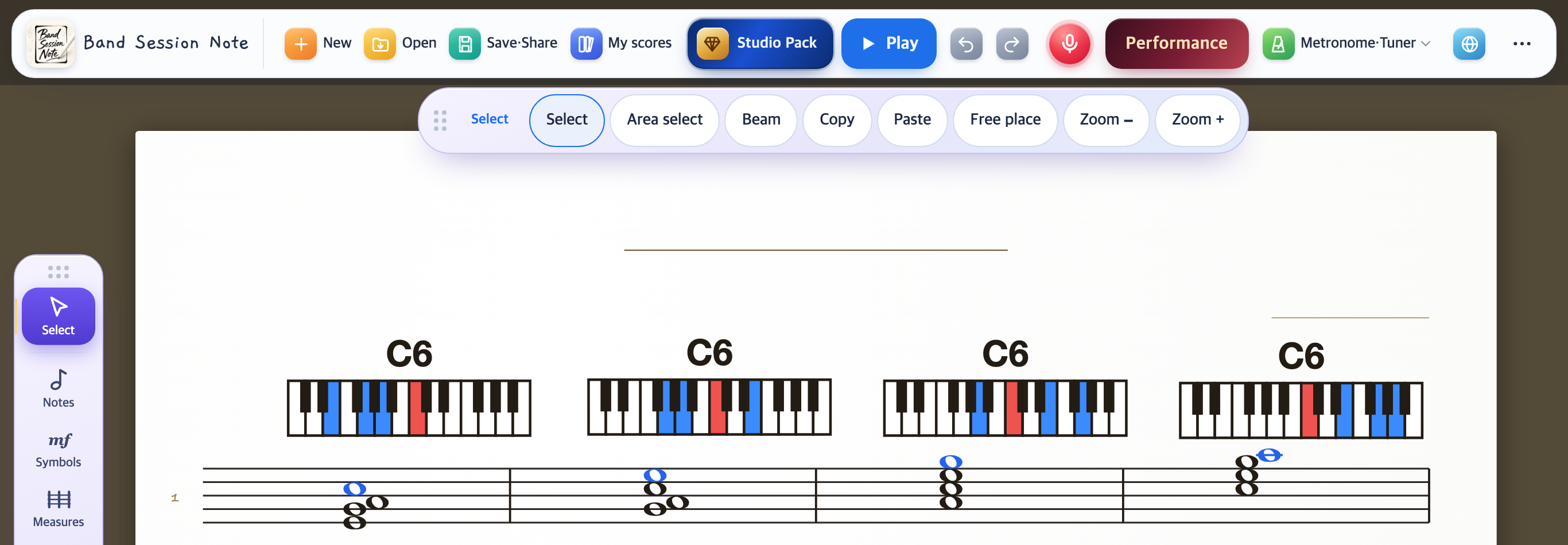
Four melody notes, four shapes, one chord. Wherever the melody goes, the other three notes follow right below it. G and A are a step apart, so in most shapes one of them is written just to the side; that is normal for a chord with a second in it.
Why C6 and not Cmaj7? With a C on top, the B of Cmaj7 would sit a half step underneath the melody, a clash most arrangers avoid. The 6th blends instead, so the 6th chord is the usual home base for block chords.
Passing notes get a diminished chord
Real melodies move by step, and half their notes are not in the chord. Here is C, D, E, F: C and E belong to C6, D and F do not.
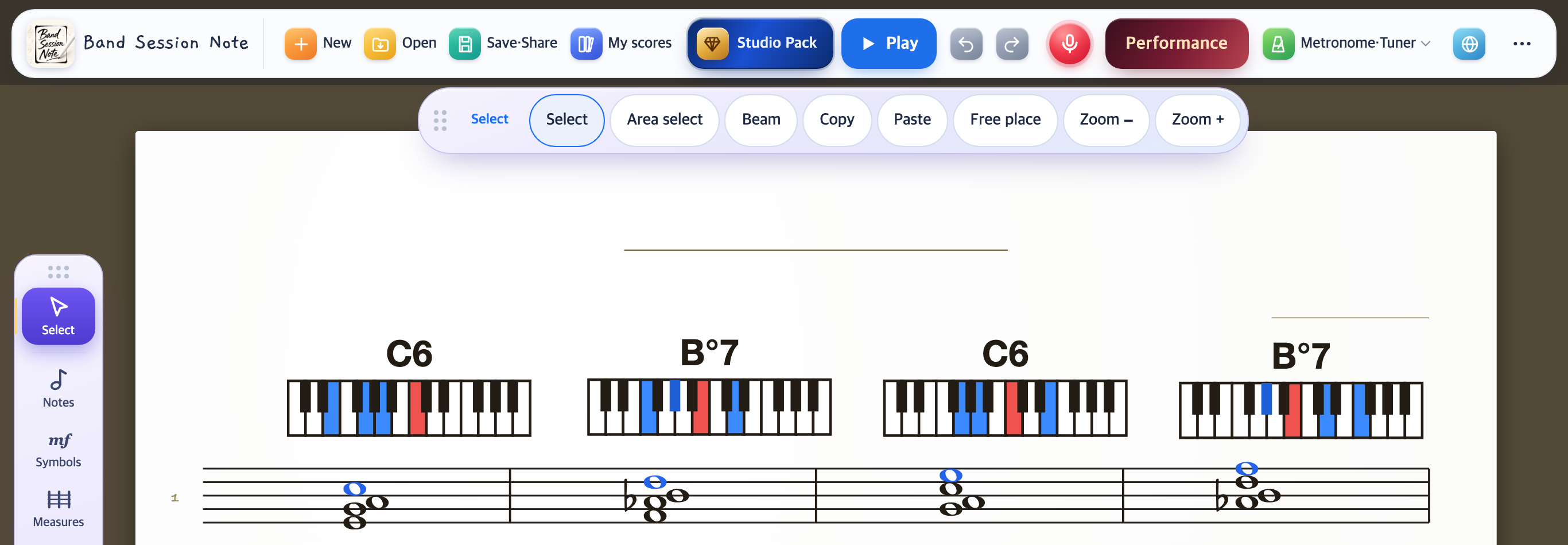
You will also see the same chord called D°7, F°7 or A♭°7. It is the same four notes: a diminished seventh chord is built from equal minor thirds, so any of its notes can be the name.
The sixth-diminished scale
Keep climbing and the two chords take turns on every note: C, D, E, F, G, A♭, A, B, C. That is the major scale with one extra note, A♭, added so that the 6th chord and the diminished chord can alternate all the way up. The pianist and teacher Barry Harris built much of his method on this sixth-diminished scale.
This is exactly what the free sheet has, in every key: nine chords per line, melody on top, the 6th chord on the chord tones and the diminished chord in between.
Locked hands
Now play the melody an octave lower in the left hand as well. Five notes, two hands moving together in the same shape.
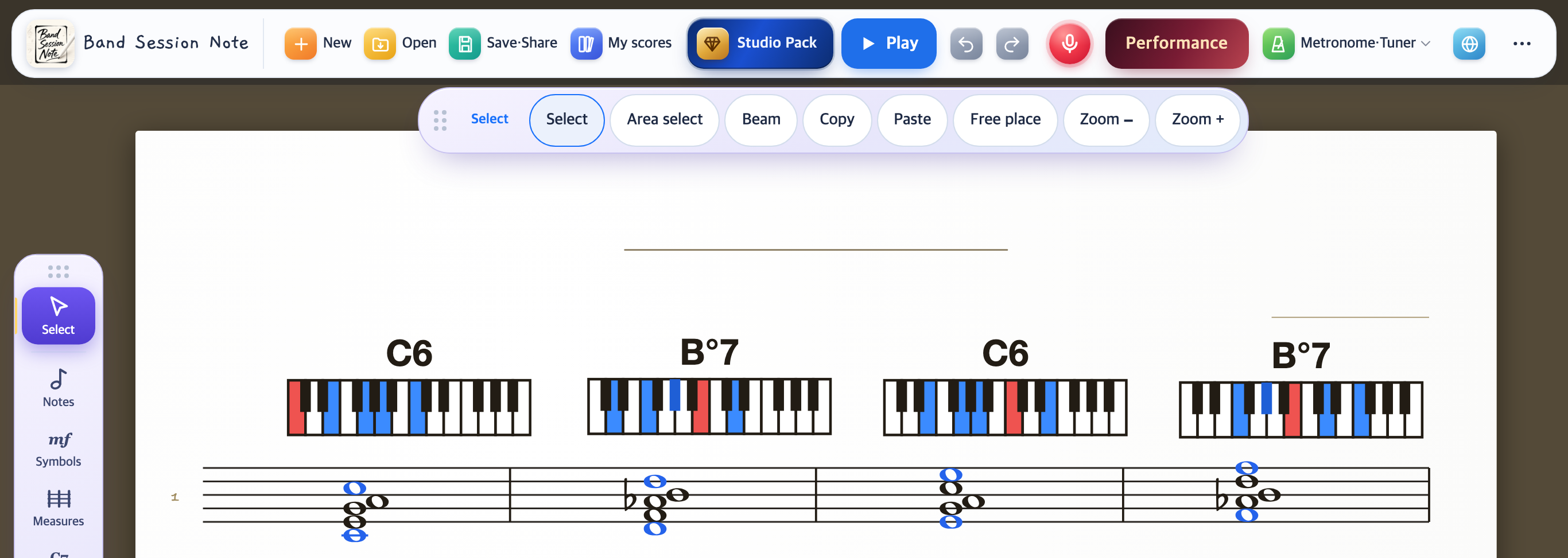
Both melody notes are blue. The hands stay close and move in parallel, which is why it is called locked hands. Milt Buckner played this way with Lionel Hampton’s band in the 1940s, partly to be heard over the horns, and George Shearing made it his signature sound.
Four common mistakes
1. Spreading the notes out. In four-way close all four notes fit inside one octave below the melody. If there is a gap, it is a different voicing.
2. Forcing the chord under every note. A C6 shape under a D melody puts the D right next to C and E. Give the passing notes the diminished chord instead.
3. Doubling notes inside the right hand. The four right-hand notes are four different notes. The only doubling is the left-hand melody in locked hands.
4. Playing it too low. Four notes this close together turn muddy below middle C. Keep the melody in the upper half of the treble staff.
How to practise it
1. Print the sheet. Play one line with the right hand only, slowly, up the scale. Each line is one key.
2. Play it back down. The chords alternate the same way in reverse.
3. Add the left hand an octave below the melody: locked hands.
4. Take a simple melody that moves mostly by step and harmonize it the same way: 6th chord on the chord tones, diminished chord on the rest.
The same idea works in minor: pair Cm6 with the same B°7 and you get the minor sixth-diminished scale. On guitar, four notes this close are hard to finger, so guitarists usually play the drop 2 version described below.
FAQ
What are block chords?
A way of harmonizing a melody so that every melody note gets its own chord, moving in parallel with the tune. The name comes from the solid “block” of sound. Arrangers voice a four-horn section the same way.
What is four-way close?
Four notes, melody on top, the other three as close below it as possible, all within an octave. It is the starting point for block chords and for big-band sax sections.
Who invented locked hands?
Milt Buckner is usually credited with it. George Shearing said he learned it from Buckner and made it famous.
How is this related to drop 2?
Take any four-way close shape and drop the second note from the top down an octave: that is a drop 2 voicing. It sounds more open and is much easier on guitar.
Every example on this page was written in Band Session Note, the iPad notation app I make. The pictures are the app’s own screen.


Comments
Post a Comment